Mosconi Cup Rivalry: USA vs Europe, History & Controversy
From Team USA’s early dominance to Europe’s modern dynasty, explore the history, personalities, crowd pressure, and controversies that built the Mosconi Cup.
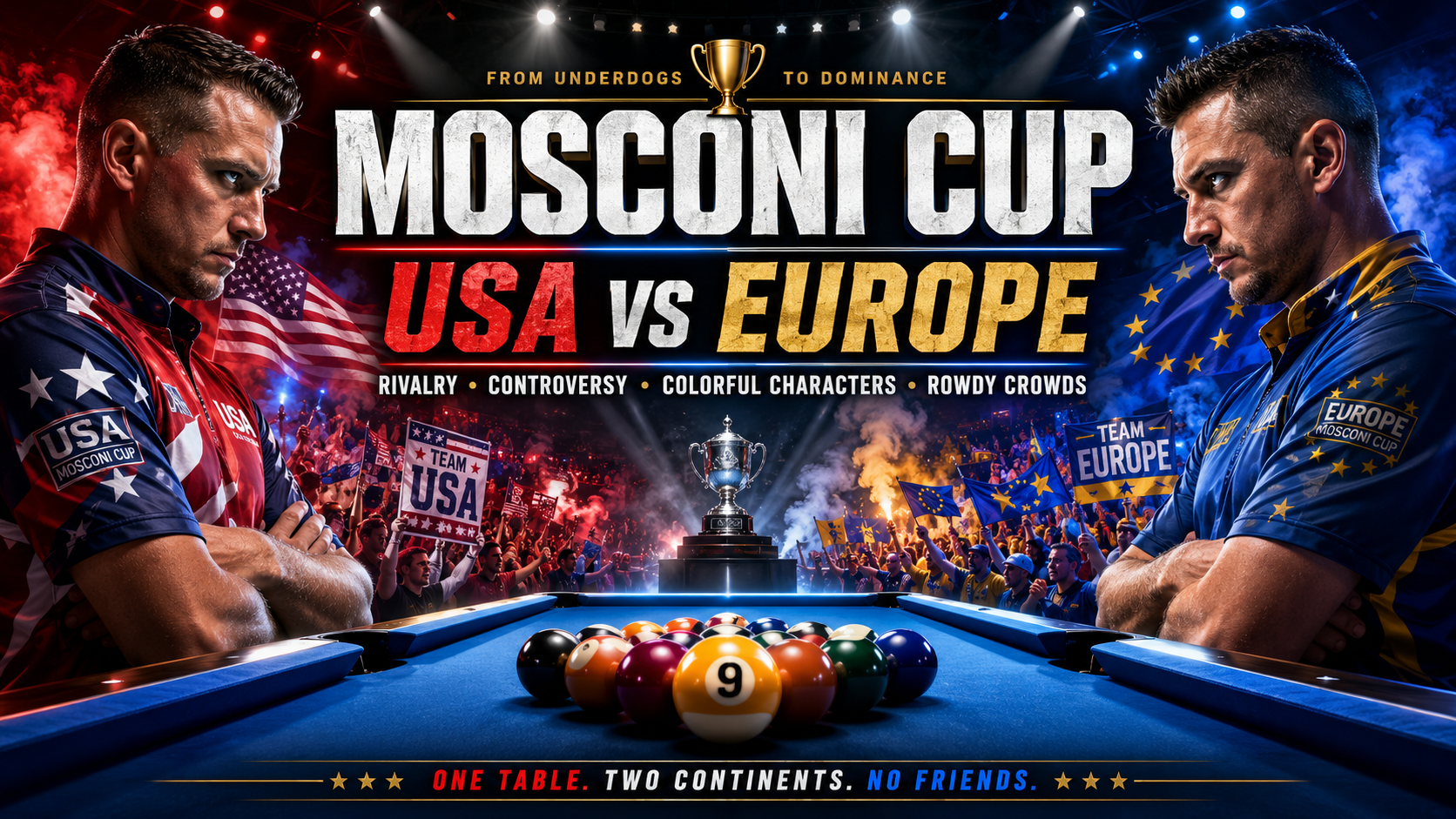
The Mosconi Cup began as a television experiment designed to introduce American 9-ball to Britain. More than three decades later, it has become pocket billiards’ loudest, most emotional, and most recognizable team rivalry—a four-day test of skill, nerve, personality, and national pride.
Key Takeaways
- The Mosconi Cup has been Team USA versus Team Europe since its first edition in 1994. It did not begin as a tournament of separate national teams.
- The event was named the Mosconi Cup from the beginning, honoring American legend Willie Mosconi shortly after his death in 1993.
- Team USA dominated the early era because American players had the deeper professional 9-ball culture and more elite experience.
- Europe’s 2002 victory proved the Americans were beatable, while the 2006 tie and Europe’s 2007 win in Las Vegas marked the true shift in power.
- Europe has won 16 of the 19 editions from 2007 through 2025, including six consecutive victories from 2020 through 2025.
- Europe’s advantage comes from depth, structured competition, year-round big-stage experience, disciplined preparation, and an unusually strong team identity.
- The chanting, singing, taunting, and pressure created by European crowds are not background noise. They are part of the competition.
From a Small Television Experiment to Pool’s Greatest Team Event
The first Mosconi Cup was staged in 1994 at the Roller Bowl in Romford, England. Barry Hearn and Matchroom wanted to create a televised event that could introduce American-style 9-ball to a British audience more familiar with snooker and English 8-ball.
Hearn openly borrowed the basic idea from golf’s Ryder Cup: take a simple transatlantic rivalry, put national and continental pride on the line, and make every rack feel more important than an ordinary tournament match.
The name came before the first ball was struck. While discussing the project with American sports manager Bill Cayton, Hearn was advised to name the event after Willie Mosconi. Mosconi had died only months earlier. Hearn contacted Mosconi’s widow, Flora, received her blessing, and the new competition became the Mosconi Cup from its inaugural edition.
The first event looked very different from the modern version. Each team had eight players—six men and two women—and matches used a best-of-three-set structure. Team Europe included elite continental pool players, recognizable snooker stars, and women’s cue-sports champions. Steve Davis, Jimmy White, Allison Fisher, Ralf Souquet, Oliver Ortmann, and other familiar names helped sell a game that much of the British public had barely seen.
Team USA also fielded a mixed roster. Jeanette Lee and Vivian Villarreal joined experienced American professionals, trick-shot artists, and veteran stars. The first American squad was not yet the full collection of dominant tour players that would arrive later, but the United States still won the inaugural contest 16–12.
What began as an exhibition soon developed into something much more serious.
A Necessary Correction: The Mosconi Cup Never Had a Multi-Nation Bracket
The Mosconi Cup did not evolve from many separate countries into only Team USA and Team Europe.
It was designed as USA versus Europe from day one.
The confusion is understandable because Team Europe has always been multinational. A single European lineup may include players from Germany, Great Britain, Spain, Austria, Finland, the Netherlands, Albania, Lithuania, Poland, or other European nations. They compete under one European banner rather than as separate national teams.
The country-versus-country Matchroom event is the World Cup of Pool, which began in 2006. That tournament uses two-player national teams in a knockout format and has featured countries from Europe, Asia, North America, and beyond.
The Mosconi Cup remained USA versus Europe because that was the commercial and emotional foundation of the event. The format was easy for television viewers to understand, it copied the proven Ryder Cup model, and it created an immediate story: the traditional home of American 9-ball against a combined European challenge.
That simplicity became one of the event’s greatest strengths.
Why Team USA Dominated the 1990s
In the early 1990s, American players held an enormous practical advantage.
The United States had a mature 9-ball culture, established professional events, strong poolrooms, money-game experience, and a generation of champions who had spent years competing under pressure. Europe had excellent cueists, but American 9-ball was still a developing discipline in much of the continent.
Several early European players came from snooker or English 8-ball. They possessed extraordinary cueing ability, but they were still learning the break, kicking systems, push-out strategy, two-way shots, and the tactical details of elite 9-ball.
The first European teams also needed recognizable television names. That is why snooker personalities such as Steve Davis, Jimmy White, and Alex Higgins were so important. They attracted viewers, even when some of them were still adapting to the game.
By 1997, more of America’s leading professional-tour players were available, and Team USA became even stronger. Earl Strickland, Johnny Archer, Nick Varner, Rodney Morris, and other elite American competitors brought championship experience and a confidence built on years of playing the game at its highest level.
The results reflected the imbalance. Team USA won 10 of the first 12 Mosconi Cups from 1994 through 2005. Its most brutal victory came in 2001, when the Americans crushed Europe 12–1.
At that point, the Europeans were still widely viewed as talented challengers trying to survive against the masters of the American game.
The 2002 Victory That Changed Europe’s Belief
Europe’s breakthrough in 2002 was more than one victory. It changed the psychology of the rivalry.
One year after suffering the 12–1 humiliation, Team Europe returned with a closer team, better preparation, and a stronger belief that the Americans could be beaten. The players practiced together, ate together, and treated the event as a collective mission rather than a collection of individual matches.
The Cup came down to one of the most famous matches in event history: Steve Davis against Earl Strickland.
With Europe one match from victory and the singles contest tied, Strickland appeared likely to keep the Americans alive. He then left the 6-ball hanging near the pocket. Davis cleared the remaining balls and sank the winning 9-ball as the York Hall crowd erupted.
Europe had ended a six-year American winning streak.
That moment gave the continent something it had lacked: proof. The Americans were still great, but they were no longer invincible. European players who had spent years learning American 9-ball could now see a path from respectable challenger to champion.
The 2006 Tie and the 2007 Transfer of Power
The 2006 Mosconi Cup in Rotterdam produced one of the event’s most controversial endings.
Europe and the United States finished tied 12–12. Under the rules in place, defending champion Team USA retained the Cup. There was no deciding match.
The outcome followed the Ryder Cup tradition, but it felt wrong for an event built around short-race drama. Players, spectators, and television viewers had watched four days of pressure only to receive no true winner. Barry Hearn later acknowledged that allowing the tie had been a mistake, and the possibility was removed from future editions.
The tension of that week also showed how far the rivalry had moved beyond exhibition pool. Earl Strickland exchanged words with opponents, challenged the atmosphere, and at one point smashed his cue shaft against the floor after an error. The crowd responded with cheers and air horns.
Then came 2007 in Las Vegas.
Europe defeated a powerful American lineup 11–8 on U.S. soil. The American roster included Strickland, Archer, Morris, Corey Deuel, and Mosconi Cup newcomer Shane Van Boening. Europe answered with a confident team led by players who no longer viewed victory as an upset.
Tony Drago won Most Valuable Player honors, Ralf Souquet pocketed the clinching 9-ball, and the balance of power shifted.
From 2007 through 2025, Europe won 16 of 19 editions. The United States interrupted that run in 2009 and then produced an impressive two-year revival in 2018 and 2019. Europe responded by winning six straight from 2020 through 2025, including an 11–3 demolition at Alexandra Palace in 2025.
The underdog era was over. Europe had become the standard.
Why Europe Wins So Often Now
Europe’s dominance is not the result of one player, one captain, or one lucky generation. It is the product of a system.
A Much Deeper Selection Pool
Team USA selects from one country. Team Europe selects from an entire continent.
That difference always existed, but it matters more now because elite 9-ball has spread far beyond the United States. Germany, Spain, Austria, Finland, the Netherlands, Great Britain, Poland, Albania, Lithuania, and other nations have produced world-class players.
Europe can lose a champion to poor form, injury, scheduling, or selection and still field another player with major-event experience. Its fifth-best available player may already be a world champion, major winner, or regular contender on the international tour.
Structured Competition and Big-Stage Repetition
For years, European players developed through the EuroTour and national federations while the United States struggled to maintain a stable, unified professional tour.
That gave Europe a large group of players accustomed to ranking pressure, international travel, formal tournament structures, and repeated competition against one another. By the time many European players reached the Mosconi Cup, they had already played dozens of high-pressure matches against world-class opposition.
The modern World Nineball Tour has created more opportunities in the United States and across the globe, but Europe’s developmental advantage produced lasting depth.
Team Preparation Instead of Five Separate Stars
The Mosconi Cup punishes individualism.
Players compete in singles, doubles, and full-team matches. Scotch doubles require partners to alternate shots, meaning one player must accept the cue-ball position left by another. Communication, rhythm, trust, and emotional control matter almost as much as pure shot-making.
Europe has repeatedly treated preparation as a team-building exercise. Captains have emphasized drills, shared practice, meals, travel, and time together before the event. Johan Ruijsink’s disciplined coaching helped establish that culture during Europe’s long winning run, and later captains continued the model.
After Europe’s 2025 victory, captain Jayson Shaw credited the team’s time together and its ability to understand one another. That unity is visible when a player struggles: European teammates remain engaged, celebrate defensive shots, and treat every rack as shared property.
Pressure Management
A normal professional 9-ball tournament may use longer races and quieter conditions. The Mosconi Cup is different.
Matches are short. A dry break, one missed 8-ball, or one failed safety can decide an entire point. The arena is loud, the opponent is close, the team is watching, and thousands of people react to every mistake.
Europe’s current players are not merely technically strong. They have become specialists in this environment. They know how to use the crowd, slow their breathing, recover from errors, and keep the emotional temperature high without losing control.
That does not mean American players lack skill. Shane Van Boening, Fedor Gorst, Skyler Woodward, and other U.S. representatives can beat anyone in the world. The problem is that the Mosconi Cup does not ask only who plays the best 9-ball. It asks which five players can function best as one unit inside a pressure chamber.
The European Crowd: Pool Meets Football and Boxing
The Mosconi Cup crowd did not become famous overnight.
The atmosphere began to change when the event moved to York Hall in East London in 1997. The historic boxing venue placed spectators close to the table. Singing, chanting, an open bar, and the natural USA-Europe rivalry transformed the room.
European players were serenaded. American misses were celebrated. The noise bounced from the balcony and low ceiling, creating the feeling that the visiting team had entered hostile territory.
Later venues—especially Alexandra Palace—expanded that atmosphere into a full arena show. Fans arrive in flags, team shirts, costumes, and face paint. They sing player-specific songs, chant between shots, celebrate safeties, and attempt to pull their side through difficult moments.
For traditional pool fans, the behavior can be uncomfortable. Pool etiquette normally demands silence while a player is down on a shot. At the Mosconi Cup, the line between passionate support and interference is constantly debated.
There have been moments when American supporters argued that crowd noise occurred too close to a stroke. There have also been American players who embraced the hostility, gestured to the crowd, and used the silence after a big win as motivation.
Skyler Woodward’s performance at Alexandra Palace in 2018 remains a perfect example. Facing European favorite Jayson Shaw, Woodward survived the pressure, won the match, and placed a hand to his ear as if asking where the songs had gone. Team USA went on to win the Cup.
The crowd can influence emotion, but it does not pocket the balls. The strongest players learn to treat the noise as part of the table conditions.
The Colorful Characters Who Built the Rivalry
The Mosconi Cup has always needed great players. It became famous because many of those players were also unforgettable personalities.
Earl Strickland: Genius, Anger, and Unscripted Television
No player represents the event’s volatility better than Earl Strickland.
Strickland possessed extraordinary shot-making ability and one of the most impressive competitive records in American pool. He also argued with crowds, opponents, referees, equipment, and sometimes himself.
In 2006, he broke a cue shaft against the floor and then returned with a replacement shaft to win the match. In 2007, his verbal battle with Daryl Peach became so heated that referee Michaela Tabb stepped between them. In other appearances, he criticized table conditions and gave live television producers more than one reason to apologize for his language.
Strickland could damage team chemistry, but he also made it impossible to look away. The Mosconi Cup’s identity as emotional sports television owes a great deal to his brilliance and unpredictability.
Steve Davis: The Calm Snooker Icon Who Became a European Hero
Steve Davis entered the event as a snooker legend helping introduce an unfamiliar game to British viewers.
He became much more than a promotional name. His 2002 victory over Strickland delivered Europe’s breakthrough and remains one of the defining scenes in Mosconi Cup history.
Davis represented the early transition from exhibition to serious competition. The fact that Matchroom eventually no longer needed snooker stars was itself proof that the Mosconi Cup had created its own heroes.
Ralf Souquet: The Bridge Between Two Eras
Germany’s Ralf Souquet was present at the first Mosconi Cup and went on to make a European-record 17 appearances.
His calm professionalism stood in sharp contrast to the louder personalities around him. Souquet lived through the early defeats, the 2002 breakthrough, and the 2007 win that announced Europe’s new era. When he sank the winning 9-ball in Las Vegas in 2007, the symbolism was perfect: one of Europe’s original pioneers completed the transfer of power.
Tony Drago and Dennis Hatch: Pure Crowd Energy
Malta’s Tony Drago played at a remarkable pace and brought the attack-minded personality of snooker and pool into the European side. His MVP performance in 2007 helped turn a major upset into a new reality.
Two years later, Dennis Hatch became the emotional engine of Team USA. Nicknamed “The Hatchet,” he fed off the Las Vegas crowd, played with visible intensity, won MVP honors, and helped deliver America’s 2009 victory.
Both players showed that the Mosconi Cup rewards more than quiet precision. Sometimes a team needs someone who can change the temperature of the room.
Jayson Shaw and Joshua Filler: Europe’s Modern Showmen
Jayson Shaw thrives in the Mosconi Cup environment. He engages the crowd, celebrates openly, talks confidently, and plays with the expectation that Europe should win. As a playing captain, he has turned swagger into leadership.
Joshua Filler arrived as a fearless young German and immediately looked built for the stage. His aggressive style, emotional celebrations, and willingness to face the strongest opponents made him one of the faces of Europe’s modern dominance.
They are not merely entertainers. Their personalities work because they are backed by elite execution.
Shane Van Boening: The Quiet American Constant
Shane Van Boening offers the opposite personality.
He is generally controlled, private, and focused on the table. His record number of appearances reflects both his individual greatness and America’s reliance on him through multiple generations of teammates.
Van Boening’s calm has made him Team USA’s anchor, but the event’s history also shows that one great player cannot carry five-person pressure alone.
The Controversies That Made the Cup Feel Real
The Mosconi Cup’s controversies usually come from the same source as its appeal: the event asks individual professionals to behave like national-team athletes in an arena designed for emotion.
The 2006 Tie
The only tied Mosconi Cup remains the clearest rules controversy. A 12–12 finish allowed Team USA to retain the trophy without a deciding match. The reaction was so negative that the event removed ties from the format.
Gamesmanship or Bad Sportsmanship?
Taunting, chair movement, post-shot celebrations, crowd gestures, and verbal exchanges have all produced arguments over where gamesmanship ends and bad sportsmanship begins.
Supporters see passion. Critics see unnecessary theater. Matchroom understands that the tension drives attention, but officials still have to protect the players’ ability to complete a shot without direct interference.
The Crowd Noise Debate
European home crowds are celebrated for creating pool’s best atmosphere and criticized for crossing traditional etiquette lines.
Both statements can be true. The singing and chanting make the event special, but noise timed during a player’s final stroke can become unfair. The strongest version of the Mosconi Cup is loud between shots and respectful at the decisive moment.
Selection and Team-Balance Arguments
Every year produces debates over captain’s picks, ranking qualifications, veterans, rookies, and whether Team USA should be expanded to include Canada or the rest of North America.
Those arguments grow louder when Europe dominates. However, changing the geographical identity would also change the event’s history. The rivalry works because the teams are familiar, the colors are fixed, and every generation inherits the same unfinished argument.
Can Team USA Take the Cup Back?
Yes. The 2018 and 2019 victories proved that Europe is not unbeatable.
Those American teams arrived with clearer preparation, stronger unity, and players who accepted defined roles. Skyler Woodward became a pressure performer, Tyler Styer handled a hostile debut, and Johan Ruijsink brought the same disciplined approach he had used with Europe.
The path back is not to recreate the 1990s. That era is gone.
America needs a deeper development system, more young players competing internationally, better continuity between captains and selection cycles, and more time together before the event. It also needs to embrace the emotional reality of the Mosconi Cup rather than wishing it behaved like a quiet singles tournament.
Europe’s success should not be treated as evidence that American pool is dead. It should be treated as a standard.
The United States once taught Europe how elite 9-ball was played. Europe studied the lesson, built a system around it, and eventually became better at delivering that game as a team.
The Rivalry Is Bigger Than the Scoreboard
The Mosconi Cup has survived blowouts, arguments, rule changes, selection disputes, and long periods of one-sided results because it gives professional pool something ordinary tournaments rarely provide: a clear emotional identity.
The players are not competing only for prize money or ranking points. They are carrying a flag, facing a hostile or supportive crowd, and relying on teammates who are normally their individual rivals.
That is why one missed 9-ball can follow a player for years. It is why a defensive shot can receive a standing ovation. It is why fans sing the name of a player they may cheer against in every other tournament.
The event began with Europe trying to survive America’s game.
It became Europe learning the game.
Then it became Europe mastering the team version of it.
Now Team USA must decide whether the next era will be another European dynasty—or the beginning of the American response.
Frequently Asked Questions
When did the Mosconi Cup begin?
The first Mosconi Cup was held in 1994 at the Roller Bowl in Romford, England. Matchroom created it as a televised USA-versus-Europe 9-ball event inspired by golf’s Ryder Cup.
When did it become known as the Mosconi Cup?
It was called the Mosconi Cup from the first edition in 1994. Bill Cayton suggested naming the event after Willie Mosconi, and Barry Hearn received permission from Mosconi’s widow, Flora.
Did the Mosconi Cup originally include separate national teams?
No. It has always been Team USA against a combined Team Europe. The World Cup of Pool, launched in 2006, is Matchroom’s separate event for two-player national teams.
Why was Europe originally the underdog?
American players had far more experience in professional 9-ball, stronger domestic events, and a generation of established champions. Many early European participants came from snooker or English 8-ball and were still learning the specialized tactics of American pool.
Why does Europe dominate the modern Mosconi Cup?
Europe combines a deep continental talent pool with structured tournament experience, strong coaching, disciplined preparation, and a team culture suited to doubles and short-race pressure.
Which team leads the all-time series?
By counting the published annual results through 2025, Europe leads with 18 victories, Team USA has 13, and the 2006 event ended in a tie. Europe has won 16 of the 19 editions from 2007 through 2025.
Why are European Mosconi Cup crowds so loud?
The event developed a football-and-boxing atmosphere after moving to York Hall in 1997. Singing, chants, flags, costumes, and partisan reactions became part of the show and later expanded at larger venues such as Alexandra Palace.
What is the current Mosconi Cup format?
Modern teams have five players. The event uses team, doubles, and singles matches, generally played as short races, with the first side to win 11 matches taking the Cup.
When is the 2026 Mosconi Cup?
The 2026 Mosconi Cup is scheduled for November 27–30 at the Caribe Royale Resort in Orlando, Florida.
Sources and Further Reading
- World Nineball Tour: Mosconi Cup—How a Modest Dream Became Pool’s Greatest Show
- Billiards Digest: Mosconi Magic—The Event’s First 25 Years
- World Nineball Tour: 2025 Mosconi Cup Results
- World Nineball Tour: 2026 Mosconi Cup Qualification and Dates
- Matchroom: World Cup of Pool History
- American Poolplayers Association: Three Defining Moments from the 2018 Mosconi Cup