The Rise of Legal Poker Rooms Across America in 2026
Live poker is expanding through licensed casinos, cardrooms, charity gaming, tribal properties, and social clubs—but legality varies sharply by state.
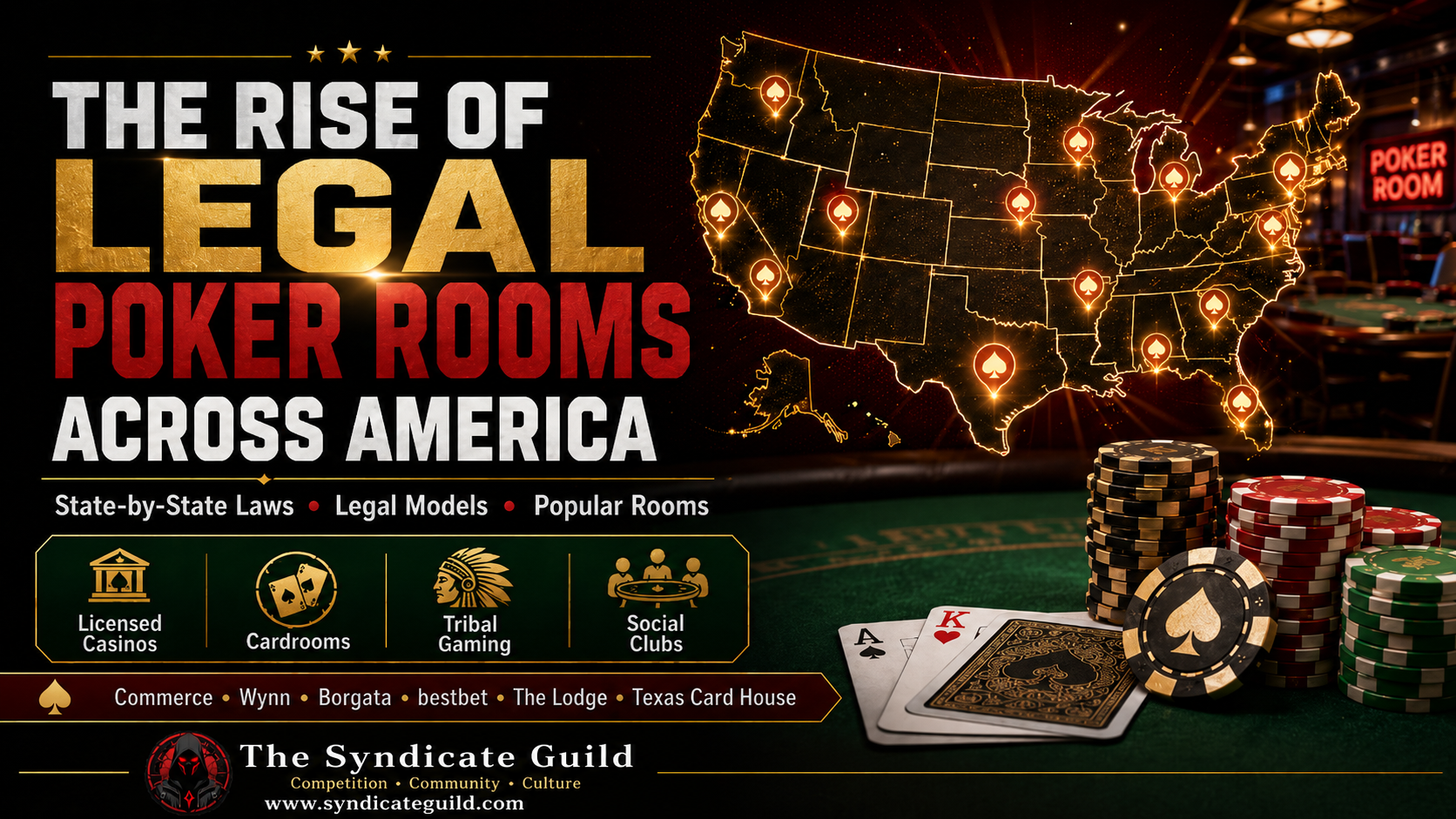
Legal poker rooms across America are expanding and reinventing themselves in 2026—but not through one nationwide law. New and renovated rooms are opening in Pennsylvania, California, Minnesota, Mississippi, and other regional markets while Las Vegas continues to consolidate. The legal foundation changes from state to state: some rooms operate under casino licenses, some under cardroom statutes, some for charities, some under tribal law, and Texas clubs rely on a contested private-place defense rather than a statewide poker-room license.
Legal notice: This article is general information, not legal advice. Gambling laws, local ordinances, licenses, and enforcement positions can change. Verify a venue with the appropriate regulator before traveling or risking money.
Quick Answer: Why Are Poker Rooms Rising Across America?
Live poker is expanding where operators can connect it to a broader entertainment property, a strong regional player base, charitable funding, or a legally recognized cardroom model. In 2026:
- Wind Creek Bethlehem opened a new 20-table room in Pennsylvania.
- Red Hawk Resort & Casino opened a seven-table poker room in California.
- Graton Resort & Casino added a new poker room in a major non-smoking expansion.
- Treasure Island Resort & Casino in Minnesota moved poker into a larger modernized space.
- Beau Rivage in Mississippi debuted a renovated 12-table room.
- Texas Card House hosted the first World Series of Poker Circuit series in Texas.
- The Lodge Card Club reopened after a raid, asset seizure, grand-jury review, and no indictment.
At the same time, Planet Hollywood and Resorts World closed their Las Vegas poker rooms in early 2026. The national trend is therefore regional growth and reinvention, not universal expansion.
Key Takeaways
- A poker room is legal only through a recognized legal framework. A sign saying “members only” does not create a license.
- States use different models. Casino licensing, stand-alone cardrooms, pari-mutuel licenses, charitable gaming, social gaming, and tribal gaming are separate systems.
- Texas has not broadly legalized commercial poker rooms. Clubs rely on statutory defenses and business models that remain vulnerable to local enforcement.
- California, Nevada, New Jersey, Florida, Washington, and Montana have clearer licensing structures.
- New Hampshire ties casino-style poker to charitable gaming.
- Oregon social gaming is narrow. A locally permitted social game cannot operate like an ordinary raked casino room.
- The best-known rooms are not necessarily the newest. Commerce Casino, Wynn, Bellagio, Borgata, bestbet Jacksonville, Texas Card House, and The Lodge remain major names for different reasons.
- No national regulator publishes a definitive popularity ranking. We assess scale, tournament activity, reputation, schedule, and documented public interest.
The Rise—and Reinvention—of American Poker Rooms
The broader U.S. gaming industry entered 2026 with record momentum. The American Gaming Association reported $78.62 billion in commercial gaming revenue for 2025, up 9.1 percent, with 493 commercial casino locations across 27 states generating $51.06 billion from traditional casino games.
That does not mean poker itself rose everywhere. Poker occupies valuable floor space and produces less direct revenue per square foot than many slot or electronic gaming products. Large resorts may close a room even when tournaments perform well. Smaller regional properties may add poker because it creates repeat visitation, food-and-beverage demand, tournaments, livestreams, and a social identity that slot banks cannot duplicate.
This explains the split visible in 2026:
Regional Properties Are Investing
Wind Creek Bethlehem's new enclosed room has 20 tables, a dedicated cage, beverage service, massage service, and a waiting lounge. Red Hawk opened seven tables with daily games and tournaments. Graton's expansion introduced a new poker room as part of a 144,000-square-foot non-smoking casino wing. Treasure Island Minnesota moved into a larger room with new televisions and more space. Beau Rivage opened a renovated 12-table smoke-free room.
Las Vegas Is Consolidating
Planet Hollywood closed its 23-table room on January 31 after less than a year back in operation. Resorts World followed at the end of March. PokerNews reported that the Resorts World closure left eight rooms on the Strip.
Las Vegas is still the center of major tournament poker, particularly during the World Series of Poker and series at Wynn, Venetian, Bellagio, Aria, and other flagship properties. The market is concentrating action in fewer, stronger rooms rather than supporting a room in every resort.
Legal Poker Rooms Across America: Six Legal Models
There is no single national license for a public poker room. The legal authority normally comes from one of six structures.
1. Licensed Commercial Casinos
States such as Nevada, New Jersey, Pennsylvania, and Mississippi authorize poker inside regulated casinos. The property, key employees, games, internal controls, surveillance, and financial systems operate under state gaming oversight.
This is the clearest model for a visitor: the poker room is part of a licensed casino, and the state has a regulator that accepts complaints and can discipline the operator.
2. State-Licensed Cardrooms
California licenses stand-alone gambling establishments and requires approval for controlled games and gaming activities. Washington licenses qualifying commercial stimulant businesses and limits them to no more than 15 card tables. Montana requires permitted tables on licensed premises under licensed dealers. Florida restricts cardroom licensing to qualifying pari-mutuel permit holders.
These rooms may look like casinos, but the legal structure can be different. In California, for example, poker is player against player, while other approved games use state-specific player-dealer arrangements rather than a conventional casino bank.
3. Charitable Gaming
New Hampshire's model allows licensed games of chance tied to charitable organizations. Current law requires the charity to receive at least 35 percent of gross gaming revenue minus prizes under the applicable arrangement.
The venue can resemble a permanent casino, but the charitable beneficiary is not window dressing. It is part of the legal structure.
4. Locally Authorized Social Gaming
Oregon law recognizes social games between players when there is no house player, house bank, house odds, or house income. A city may authorize social gaming under state law.
Portland's code illustrates how narrow this can be: the room needs a permit, cannot generate house income from the game, and limits a player's bet to $1 per game. That is not the same business model as a conventional casino poker room collecting rake.
5. Private-Place or Membership-Club Defenses
Texas is the most important example. Texas Penal Code Section 47.02 makes betting on card games an offense but provides a defense when the gambling occurs in a private place, nobody receives an economic benefit other than personal winnings, and all participants have equal risks and chances apart from skill or luck.
Poker clubs have tried to fit that defense by charging membership or seat-time fees instead of taking a percentage of each pot. The problem is that the statute supplies a defense to prosecution; it does not create a statewide poker-room license or guarantee that every club model is lawful.
6. Tribal Gaming Under Federal Law
The Indian Gaming Regulatory Act creates a separate federal and tribal framework. Non-banked card games can qualify as Class II gaming under defined conditions. Tribes are the primary regulators of Class II gaming, with National Indian Gaming Commission oversight. Class III gaming generally requires a tribal-state compact and other approvals.
That is why a poker room on tribal land may be lawful even when the surrounding state's commercial casino laws look different. The legal authority comes through tribal sovereignty, IGRA, approved ordinances, and—in relevant cases—compacts.
State-by-State Guide to Legal Poker-Room Models
California: Licensed Cardrooms and Tribal Casinos
California has one of the country's deepest live-poker traditions. The Department of Justice maintains an official list of licensed gambling establishments, and state law requires owners and key participants to obtain licenses. Controlled games, tournaments, jackpots, and other gaming activities require approval and must comply with local ordinances.
Legal path: State-licensed cardroom or authorized tribal gaming.
What is not lawful: Running a public room for profit without the required state and local authority.
Notable rooms: Commerce Casino, Bay 101, The Bicycle Casino, Gardens Casino, Hustler Casino, plus tribal poker rooms such as Red Hawk and Graton.
Commerce remains the scale benchmark. Published table counts vary by source and by how poker and other controlled games are counted, but it is consistently described as one of the largest cardrooms in the world.
Nevada: Full Casino Licensing
Nevada's Gaming Commission is the final authority on gaming licenses and can approve, condition, suspend, or revoke them. Public casino poker operates inside that mature licensing and enforcement system.
Legal path: Poker offered by a licensed nonrestricted gaming property.
What is not lawful: An unlicensed public poker business operating outside Nevada's gaming framework.
Notable rooms: Wynn Las Vegas, Bellagio, Aria, Venetian, Horseshoe, Caesars Palace, MGM Grand, and South Point.
The market is strong but concentrated. Wynn operates 24 hours a day and offers daily tournaments plus its 2026 Signature Series. Bellagio remains a destination for medium- and high-limit Hold'em, mixed games, and large no-limit action.
New Jersey: Atlantic City Casino Poker
The New Jersey Casino Control Commission licenses Atlantic City casinos and key employees, while the Division of Gaming Enforcement regulates the industry and state police enforce criminal law inside casinos.
Legal path: Poker inside a licensed Atlantic City casino.
Notable room: Borgata.
Borgata remains the East Coast flagship. Its 2026 schedule included more than $4.3 million in July guarantees, regular weekly tournaments, major seasonal opens, and a broad cash-game selection.
Pennsylvania: Regulated Casino Rooms and New Investment
Pennsylvania allows live poker within state-regulated casinos. The 2026 opening at Wind Creek Bethlehem is one of the clearest examples of renewed regional investment.
Legal path: Poker within a licensed casino under Pennsylvania gaming oversight.
Notable rooms: Wind Creek Bethlehem, Parx Casino, Rivers Casino properties, and Live! Casino Philadelphia.
Wind Creek's new 20-table room is designed as a permanent amenity rather than a temporary tournament area, with its own cage and player lounge.
Florida: Pari-Mutuel Cardroom Licenses
Florida does not offer an ordinary new-business path to open a cardroom. The Florida Gaming Control Commission states that only qualifying pari-mutuel permit holders that held an operating license in fiscal year 2020–2021 may hold a cardroom license. Operating without an FGCC license is illegal.
Florida also has a narrow private “penny-ante” exception: players must be at least 18, nobody can profit from operating the game, and a player's winnings in a single hand, round, or game cannot exceed $10.
Legal path: FGCC-licensed cardroom held by a qualifying pari-mutuel permit holder.
What is not lawful: An unlicensed operator collecting rake, commission, or another profit from the game.
Notable room: bestbet Jacksonville.
bestbet's official site calls Jacksonville Florida's largest poker room and lists 91 gaming tables, with poker variants, table games, simulcast wagering, and a livestream table.
Washington: Licensed Cardrooms With Local Veto Power
Washington permits qualifying “commercial stimulant” businesses—primarily food-and-drink establishments—to apply for card-game licenses. The state allows nonhouse-banked poker and certain house-banked card games, but a commercial cardroom may not operate more than 15 tables.
Cities and counties can prohibit some or all gambling activities, including cardrooms. A state license therefore does not override a local ban.
Legal path: State-licensed commercial cardroom in a jurisdiction that permits it.
What is not lawful: Offering cards or dice for profit without a license. Washington expressly states that only licensed cardrooms may collect a fee or percentage from card games.
Montana: Licensed Operators, Tables, and Dealers
Montana's Department of Justice states that only gambling specifically authorized by statute or rule is allowed. Live poker generally must be played on a permitted table, on the premises of a licensed operator, and under the control of a licensed dealer.
The state also issues tournament permits and cardroom-contractor licenses.
Legal path: Licensed premises, permitted live table, licensed dealer, and any required tournament authority.
What is not lawful: Public gambling that is not specifically authorized.
New Hampshire: Poker Through Charitable Gaming
New Hampshire's charitable-gaming model supports permanent venues and recurring poker activity, but licensed charitable organizations remain central to the structure. The law requires the charity to receive no less than 35 percent of gross revenue minus prizes under the relevant game-operator arrangement.
Legal path: Licensed games of chance conducted with a qualified charitable organization and licensed operator.
What is not lawful: Using “charity” as a label while ignoring the license, contracts, reporting, approved games, or mandated charitable share.
Notable market: The state's charitable casinos, including large rooms in the Seabrook and Nashua areas, have become important New England poker destinations.
Oregon: Narrow Social Gaming, Not Ordinary Casino Poker
Oregon defines a social game as player-versus-player gambling with no house player, bank, odds, or income. Local governments decide whether to authorize these games in businesses or clubs.
Portland requires a permit and currently limits betting to $1 per game while prohibiting house income from the game's operation. A room cannot simply charge conventional rake and call itself social gaming.
Legal path: A qualifying social game authorized by local ordinance, or tribal gaming under the applicable federal framework.
What is not lawful: A house-banked or house-profiting game outside another legal authorization.
Texas: A Fast-Growing Market Without Clear Statewide Licensing
Texas has produced some of the most visible poker growth in America, but it has not created a conventional poker-room licensing system.
Clubs rely on the private-place defense in Penal Code Section 47.02. The defense requires:
- A private place
- No economic benefit to anyone other than personal winnings
- Equal risks and chances for all participants except for skill or luck
Membership and seat-time fees are designed to avoid pot rake, but prosecutors and clubs do not always agree that the model satisfies the statute.
The Lodge Card Club shows the uncertainty. Authorities raided the Round Rock room in March 2026 and froze assets while investigating suspected illegal gambling and other offenses. A grand jury later declined to indict, and the room reopened May 26. A no-bill means the proposed criminal charges did not obtain the necessary grand-jury support. It is not a Texas Supreme Court ruling, a new statute, or a statewide license for every poker club.
Texas Card House shows the other side of the market. It hosted the state's first official WSOP Circuit series in April and May 2026. The Main Event drew 1,709 entries and generated a $2,589,135 prize pool.
Legal position: Active but contested private-club market; not broad affirmative legalization.
Practical advice: Verify the club's current operating status, city rules, fee structure, cashout procedures, and any recent enforcement before making a special trip.
Tribal Poker Rooms: A Separate Legal Foundation
Tribal rooms deserve their own category because they do not operate merely by borrowing a state's commercial casino license.
Under IGRA, tribes may conduct and regulate qualifying Class II gaming on eligible Indian lands when statutory conditions are met and the tribal ordinance is approved. Non-banked card games can fall into Class II. Class III games require additional conditions, including an effective tribal-state compact or approved procedures.
In 2026, several of the most visible room investments were at tribal properties:
- Red Hawk Resort & Casino opened a seven-table room in California.
- Graton Resort & Casino added a new poker room within a major expansion.
- Treasure Island Resort & Casino in Minnesota opened a larger modernized room.
A visitor should look for the tribal gaming commission or other regulatory authority identified by the property, not assume that the state commercial regulator is the only source of authority.
The Most Popular and Influential Poker Rooms in 2026
There is no audited national attendance table for live poker. The following rooms stand out because of scale, game selection, major tournament schedules, public visibility, or documented 2026 activity.
Commerce Casino — California's Scale Leader
Commerce is the room most often associated with sheer table capacity and round-the-clock Los Angeles poker. It spreads a wide range of limits and variants and has decades of tournament history. Exact published table totals vary, but its status as one of the world's largest cardrooms is not seriously disputed.
Best for: Maximum game variety and the Los Angeles poker ecosystem.
Wynn Las Vegas — Premium Tournament and Cash-Game Experience
Wynn operates 24/7 at Encore, offers daily tournaments outside major series, and scheduled its 2026 Signature Series for August 17 through September 7.
Best for: A polished room, strong series, and a mix of serious recreational and professional traffic.
Bellagio — Iconic High-Limit and Mixed Games
Bellagio remains one of poker's most recognizable addresses. Its official room promotes medium- and high-limit Hold'em, mixed games, PLO double-board bomb pots, and larger no-limit games.
Best for: High-limit atmosphere, mixed games, and poker history.
Borgata — The East Coast Tournament Anchor
Borgata combines a major cash room with large seasonal tournament guarantees. Its July 2026 schedule promoted more than $4.3 million in guarantees.
Best for: East Coast tournament travel and a deep Atlantic City poker schedule.
bestbet Jacksonville — Florida's Largest Room
bestbet Jacksonville's official listing describes 91 gaming tables and a broad game mix. It also supports live-streamed poker and major regional series.
Best for: Florida and Southeast players seeking a large legal cardroom.
Texas Card House — Texas Tournament Momentum
Texas Card House became nationally significant by hosting the first WSOP Circuit stop in the state. The record-setting 1,709-entry Main Event demonstrated that Texas can produce major tournament demand.
Best for: Large Texas tournament fields—while understanding the state's unsettled legal framework.
The Lodge Card Club — Scale, Livestreams, and Legal Scrutiny
The Lodge has nearly 70 tables and a public livestream. Its 2026 raid, closure, grand-jury no-bill, and reopening made it both one of the best-known and most legally scrutinized rooms in the country.
Best for: Austin-area cash games and tournaments, with a strong warning to check current conditions.
Wind Creek Bethlehem — A Major New Regional Room
Wind Creek's new 20-table room is one of the most substantial physical poker-room openings of 2026.
Best for: Pennsylvania and Northeast players who want a newly built regulated casino room.
How to Tell Whether a Poker Room Is Legitimate
A legal room should be able to identify the authority under which it operates.
Verify the Regulator
Look for a state gaming commission, state police or justice department listing, tribal gaming commission, charitable-gaming license, or local social-gaming permit. Verify it on the regulator's website rather than relying only on a logo in the lobby.
Understand How the Room Earns Money
Legal models differ:
- Casino or cardroom rake
- Time collection
- Tournament fees
- Membership dues
- Charitable operator arrangements
- No house income under a social-game model
A fee is not automatically illegal, but it must fit the law and license governing that room.
Check Local Rules
Washington localities may ban cardrooms. Oregon social gaming depends on local authorization. Texas enforcement can differ by county or city. A statewide summary is not enough.
Review Cashout and Player-Fund Procedures
A reputable room clearly explains chip redemption, tournament payouts, identification rules, and dispute contacts. Avoid side payment apps, unofficial agents, or arrangements that move money outside the regulated cage or published club system.
Do Not Confuse Poker With Other Gambling
A room authorized for poker may not be authorized for sports betting, slot-style machines, casino banking games, or online wagering. One lawful activity does not legalize everything under the same roof.
Treat Secrecy as a Warning
A legitimate public room should not need secret passwords, rotating addresses, hidden entrances, or instructions to lie to law enforcement. Those are warning signs, even though no single fact decides legality.
Common Red Flags for an Illegal or Unregulated Operation
The exact legal test depends on the state, but these are reasons to stop and verify:
- The operator cannot name its regulator, license, charity, tribe, or local permit.
- A “social” room takes rake despite a law prohibiting house income.
- A Florida room operates without an FGCC cardroom license.
- A Washington room charges for games without a state cardroom license.
- A Montana public game lacks a licensed premises, permitted table, or licensed dealer.
- A Texas club claims that membership alone makes all gambling legal.
- Player funds move through personal payment accounts or informal agents.
- The room offers unlicensed sports betting, slot machines, or online casino play.
- Rules, fees, and payout procedures are not published.
- Management discourages players from asking about legal authority.
Do not accuse a business of a crime based only on appearance. Report concerns to the relevant regulator or law-enforcement agency and let the facts be investigated.
Responsible Poker: Entertainment, Not Income
Poker contains skill, but short-term results are volatile and the house or operator collects fees. Treat buy-ins as entertainment spending, not rent money, emergency savings, or guaranteed income.
Set a loss limit before entering. Do not borrow to play. Do not chase losses by moving to higher stakes. Take a break when poker stops being enjoyable or begins affecting work, relationships, sleep, or finances.
The National Problem Gambling Helpline offers free, confidential, 24/7 support in all 50 states. Call or text 1-800-MY-RESET or use its online chat.
Frequently Asked Questions
Which states allow legal live poker rooms?
Many states allow poker through licensed commercial casinos, tribal casinos, cardrooms, pari-mutuel facilities, or charitable gaming. The legal structure—not merely the state name—matters. Nevada, New Jersey, Pennsylvania, California, Florida, Washington, Montana, and New Hampshire all have recognized pathways, but their rules differ substantially.
Are Texas poker rooms legal?
Texas has no ordinary statewide commercial poker-room license. Clubs rely on the private-place defense in Penal Code Section 47.02 and typically avoid pot rake by using membership or time fees. Enforcement and legal interpretation remain contested. A room operating today is not proof that every similar club is lawful.
Did The Lodge raid make Texas poker illegal?
No single raid made all Texas poker illegal. The Lodge was raided and temporarily closed, but a grand jury declined to indict and the room reopened. That outcome also did not create statewide legalization or binding appellate precedent.
Why can Florida have big poker rooms if casino gambling is restricted?
Florida law allows cardrooms held by qualifying pari-mutuel permit holders that receive an FGCC license. That specific statutory path supports large rooms such as bestbet Jacksonville. An ordinary business cannot simply open the same operation without qualifying authority.
How does New Hampshire charitable poker work?
Licensed charities and game operators participate under the state's games-of-chance law. The charity must receive the legally required share—at least 35 percent of gross revenue minus prizes under the relevant operator arrangement—and the games, facility, contracts, and reporting are regulated.
Are Oregon poker clubs legal?
Only when the game fits Oregon's social-game rules and local authorization. There can be no house player, bank, odds, or income. Portland also requires a permit and imposes a $1-per-game betting limit. That is much narrower than casino poker.
Are tribal poker rooms state licensed?
Not always in the same way as commercial casinos. Tribal gaming rests on tribal sovereignty and federal law under IGRA, approved tribal ordinances, and—when required—tribal-state compacts. The tribal gaming commission is often a primary regulator.
What is the biggest poker room in America?
Commerce Casino is widely recognized as one of the largest cardrooms in the world, although published table totals vary based on configuration and whether sources count poker-only or all controlled-game tables. For a verified state-specific claim, bestbet Jacksonville identifies itself as Florida's largest room with 91 gaming tables.
Which poker room is best for tournaments?
It depends on region and schedule. Wynn and Borgata run major series, Commerce has deep tournament history, and Texas Card House proved its drawing power with a 1,709-entry WSOP Circuit Main Event in 2026. Always check the current official calendar before traveling.
How can I report a suspicious poker room?
Contact the state gaming regulator, tribal gaming commission, charitable-gaming regulator, local permitting office, or law-enforcement agency with jurisdiction. Preserve advertisements, receipts, fee descriptions, and other factual information without confronting staff or making unsupported public accusations.
Final Verdict: Poker Is Growing Where the Legal Model Works
The rise of poker rooms across America is real, but it is not uniform.
Regional casinos and tribal properties are investing in rooms that create community, tournaments, and repeat visits. California remains the cardroom capital. Nevada still owns poker's biggest stage even as the Strip consolidates. New Jersey and Pennsylvania support major regulated casino rooms. Florida's pari-mutuel model produces large cardrooms. Washington and Montana use detailed licensing. New Hampshire has turned charitable gaming into a meaningful poker market.
Texas is the outlier: enormous demand, famous rooms, major tournaments, and no clear statewide licensing system. Its clubs operate in a legal environment where a statutory defense, local enforcement, and business-model details can decide whether a room stays open.
The strongest lesson for players is simple: do not judge legality by popularity. A packed room, celebrity owner, livestream, or major tournament does not replace a license or other valid legal authority.
Find the regulator. Understand the operating model. Verify the current status. Then play within a budget you can afford to lose.
Sources and Methodology
- American Gaming Association: State of the States 2026
- California DOJ licensed gambling establishments
- California DOJ cardroom licensing overview
- Florida Gaming Control Commission FAQ
- Washington State Gambling Commission: commercial card games
- Washington local gambling bans
- New Hampshire RSA 287-D:19
- Montana DOJ licenses and permits
- Oregon Revised Statutes Chapter 167
- Portland social-games code
- Texas Penal Code Chapter 47
- National Indian Gaming Commission: Indian Gaming Regulatory Act
- Wynn Las Vegas Poker Room
- Bellagio Poker Room
- Borgata Poker Room
- bestbet Jacksonville
- Wind Creek Bethlehem Poker Room
- Pennsylvania Gaming Control Board: Wind Creek Bethlehem casino license
- Graton Resort & Casino expansion and new poker room
- Treasure Island Minnesota: new poker room
- Beau Rivage new poker room
- WSOP: Texas Card House Circuit series
- PokerNews: The Lodge reopening
- PokerNews: Resorts World and Las Vegas room closures
- National Problem Gambling Helpline
Venue status, schedules, and legal-source pages were reviewed July 27, 2026. “Popular” reflects documented scale, tournament activity, brand recognition, and public visibility—not an audited national attendance ranking.