Carbon Fiber vs Wood Pool Cue Shafts: Pros and Cons
Carbon fiber shafts promise low deflection, durability, and consistency. Wood delivers familiar feel, feedback, and tradition. Here is how to choose.
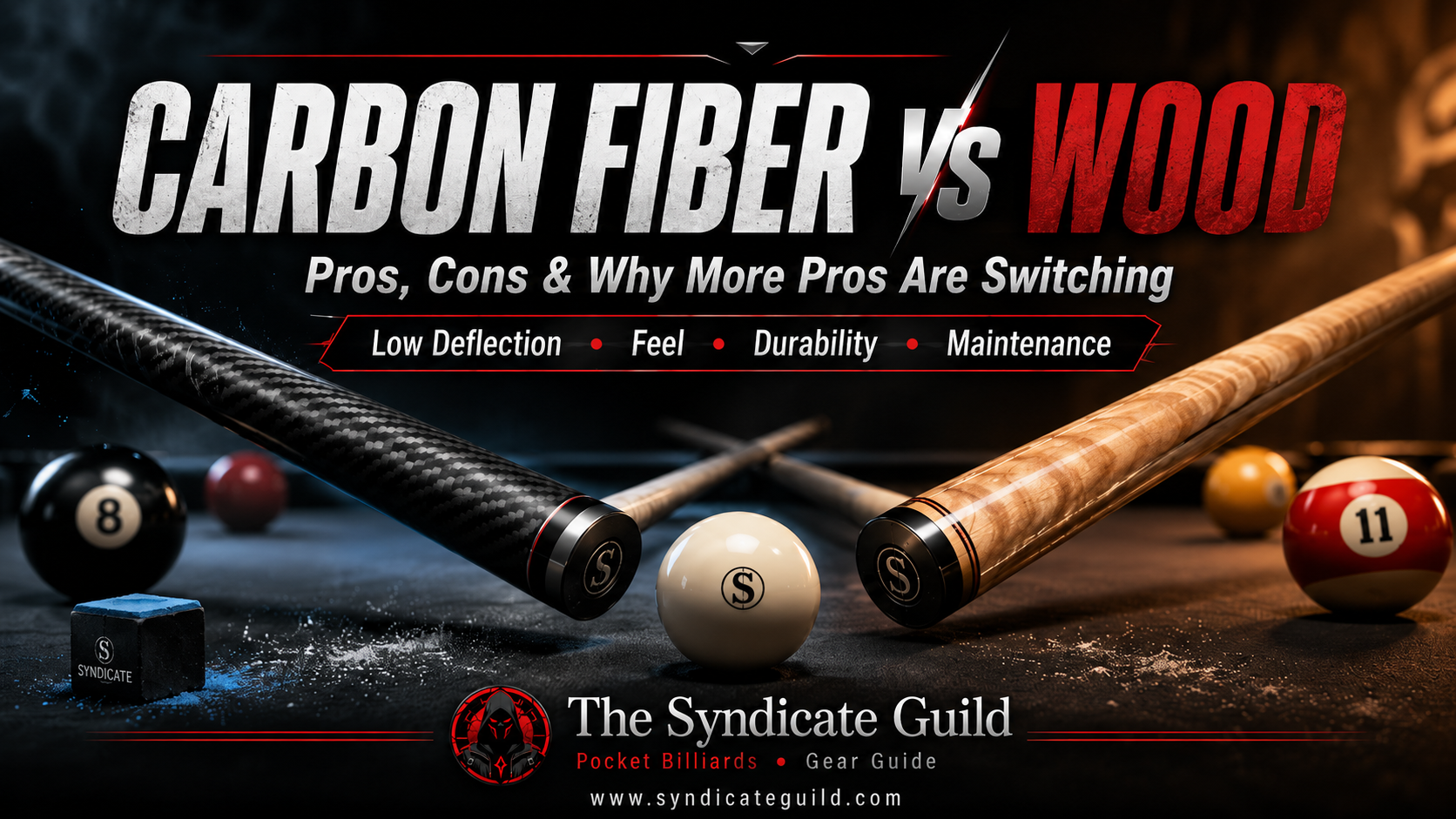
Carbon fiber pool cue shafts have moved from novelty to mainstream tournament equipment. Their strongest advantage is not magic power; it is repeatability. Wood shafts remain fully competitive because feel, feedback, familiarity, and craftsmanship still matter. The right choice depends on which variables help you play with the most confidence.
Key Takeaways
- Carbon fiber shafts are usually chosen for low deflection, dimensional stability, a smooth surface, and reduced maintenance.
- Wood shafts remain popular for their warmer hit, familiar vibration, natural appearance, repairability, and lower-cost options.
- Low deflection comes mainly from reduced effective mass near the tip—not from carbon fiber by itself.
- Modern low-deflection wood and hybrid shafts can perform much closer to carbon than a traditional solid-maple shaft.
- Many touring professionals value carbon because it removes equipment variables while traveling between climates and venues.
- Traditionalists often stay with wood because years of aiming compensation and speed-control feel are already built around it.
- Neither material fixes a poor stroke. A shaft changes the response you must learn; it does not replace fundamentals.
Carbon Fiber vs Wood Pool Cue Shafts: What Are We Really Comparing?
When players say “carbon fiber cue,” they usually mean a carbon fiber playing shaft attached to a wood, composite, or decorated cue butt. The shaft has the largest influence on cue-ball deflection, bridge-hand feel, vibration, taper, and the visual reference near the tip.
The comparison is also more complicated than “carbon versus one-piece maple.” Today’s market includes:
- Traditional solid-maple shafts
- Spliced or laminated low-deflection wood shafts
- Maple shafts with hollow or lightweight front ends
- Wood shafts with carbon or composite cores
- Glass-bonded maple shafts
- Full carbon-fiber composite shafts with foam or dampening cores
That matters because a premium low-deflection wood shaft may play much closer to a carbon shaft than it does to a conventional house cue. Material is important, but construction, front-end mass, taper, diameter, tip, ferrule, joint, and total shaft weight also shape the hit.
The Physics: Why Low Deflection Matters
When you strike the cue ball away from center, the ball immediately moves slightly opposite the direction of the tip offset. Players usually call this cue-ball deflection or squirt.
A low-deflection shaft reduces that initial sideways movement. It does not eliminate it, and it does not eliminate swerve or throw. You still need to learn how speed, cue elevation, cloth, distance, and spin change the final path.
The most important shaft variable is effective front-end mass. Dr. Dave Alciatore’s cue-testing work shows that reducing mass near the tip and ferrule reduces squirt. Carbon fiber gives engineers a useful way to build a light front end while keeping the shaft strong and dimensionally stable. Wood-shaft makers reach the same goal with smaller ferrules, hollow cores, spliced construction, lighter materials, and reduced diameters.
This is the first myth to remove:
Carbon fiber is not automatically low deflection, and wood is not automatically high deflection. Design matters more than the label alone.
The Pros of Carbon Fiber Pool Cue Shafts
1. Consistent Performance Across Climate and Travel
Wood is hygroscopic, which means it exchanges moisture with the surrounding air. Quality maple is carefully dried, selected, sealed, and stored, but it remains a natural material. Humidity changes, heat, poor storage, and repeated travel can affect its surface and dimensional stability.
Carbon-fiber composite shafts are far less sensitive to those environmental changes. For a touring professional moving between a humid Asian venue, a dry Las Vegas ballroom, and a heavily air-conditioned European arena, that consistency has real value. The player can unpack the cue and expect the shaft to remain straight and feel familiar.
This is probably the strongest practical reason professionals have adopted carbon—not because every shot becomes easier, but because one equipment variable becomes more predictable.
2. Very Low Deflection Is Easier to Engineer
Carbon fiber’s strength-to-weight properties let manufacturers reduce mass near the tip without leaving the front of the shaft fragile. Predator, Cuetec, Mezz, and other companies use different tube structures, cores, tapers, ferrules, and tip plates, but the design objective is similar: keep the effective front end light and stable.
Less squirt means less aim compensation when using side spin. For rotation players who regularly use inside English, check side, and precise three-rail position routes, reducing that compensation can simplify the visual picture.
The advantage is not that carbon “aims for you.” The advantage is that its response can be engineered within a narrow performance window and reproduced from shaft to shaft.
3. Smooth, Low-Maintenance Surface
A clean carbon shaft has a slick, consistent surface that many players enjoy through an open or closed bridge. It does not have exposed wood grain that gradually becomes rough, blue with chalk, or raised by moisture.
Routine care is usually simple: wipe it with a clean microfiber cloth and use the cleaning method specified by the manufacturer. Cuetec, for example, instructs Cynergy owners to use a soft cloth and isopropyl alcohol of 75 percent or higher. Predator publishes its own product-specific cleaning instructions, which differ in some details. Always follow the maker of the shaft you own rather than applying one universal cleaning rule.
The important rule across major brands is clear: do not sand a carbon-fiber shaft.
4. Strong Resistance to Dings, Dents, and Warpage
Carbon shafts are not indestructible, but their outer surface is much more resistant to the everyday dings that can make a maple shaft uncomfortable in the bridge hand. Major manufacturers also offer warpage protection on premium carbon shafts.
That is useful for league players carrying cues through crowded bars and especially useful for professionals whose cases move through airports every month.
A small warning belongs here: carbon shafts are designed for straight-line cueing forces, not extreme lateral bending or striking furniture and tables. Both Predator and Cuetec warn against excessive sideways pressure. Durable does not mean abuse-proof.
5. Repeatable Manufacturing and Backup-Shaft Confidence
Natural wood has grain, density, and stiffness variation. Good cue makers select and match wood carefully, but no two pieces are literally identical.
Composite manufacturing gives brands more control over wall thickness, fiber orientation, core material, taper, and front-end construction. Two carbon shafts can still differ in weight, tip installation, and final feel, but it is generally easier to obtain a close backup than it is to duplicate a favorite piece of maple.
For a professional, that matters. A damaged tip or lost case should not require rebuilding years of trust in a completely different shaft.
6. Modern Carbon Shafts Offer More Feel Than Early Models
The first generation of carbon products earned criticism for a hard, hollow, or metallic hit. Manufacturers responded with foam cores, vibration dampening, different fiber layups, ferrules, tip plates, and longer tapers.
Cuetec openly describes its foam core as an attempt to create a more wood-like sound and feedback. Mezz uses a vibration-dampening core in the Ignite. This does not make every carbon shaft feel like maple, but it explains why current products vary so much.
A player who disliked one early carbon shaft should not assume every modern carbon shaft will feel the same.
The Cons of Carbon Fiber Pool Cue Shafts
1. The Hit Can Feel Too Stiff, Muted, Hollow, or Artificial
“Feel” is subjective, but it is not meaningless. Vibration, sound, flex, tip compression, and the way energy returns through the bridge hand all contribute to how a player judges a hit.
Some players describe carbon as crisp and clean. Others call the same response hollow, dead, overly stiff, or disconnected from the cue ball. Neither side is imagining it. Different hands value different feedback.
Billiards Digest has documented elite players returning to wood because touch and familiar cue-ball response mattered more to them than the theoretical benefits of carbon. That is especially understandable for players who built decades of speed control around a specific maple taper.
2. Switching Requires a Real Aiming Adjustment
A player who has used a conventional wood shaft for years has already learned to compensate for its squirt—often without consciously calculating anything.
Move to a much lower-deflection shaft and the old compensation can cause misses. The player may overcut or undercut spin shots until the visual system recalibrates.
That is why a carbon shaft can initially make a strong player look worse. The equipment is not necessarily wrong. The learned aiming map no longer matches the shaft.
Give a serious switch several practice sessions, not fifteen minutes at a vendor booth.
3. Carbon Fiber Costs More
Premium carbon shafts remain expensive. During this July 2026 review, Cuetec listed many Cynergy playing shafts at $499, while Mezz listed the Ignite 12.2 at $599. By comparison, official prices for wood or wood-composite low-deflection options ranged from about $179 for a Cuetec AVID shaft to $359 for Predator 314-3 or Z-3 models, with some premium wood and hybrid products priced higher.
Prices change, and inexpensive carbon options exist, but the general tradeoff remains: carbon usually requires a larger upfront investment.
That investment makes sense only if you value the stability, surface, durability, and response. Buying carbon simply because a champion uses it is an expensive substitute for testing.
4. Repairs and Modifications Are More Restricted
A qualified cue repair professional can often clean up, refinish, retaper, or address minor surface problems on a maple shaft. Carbon shafts are less forgiving of improvised work.
Predator and Cuetec both warn that sanding or abrasive treatment can damage the outer layers, release harmful dust, weaken the shaft, and void the warranty. Some tip, ferrule, or tip-plate work should be performed only by an authorized or experienced repair center.
A maple shaft may collect more small defects, but many of those defects are locally repairable. A seriously damaged carbon shell may require factory service or full replacement.
5. The Black Shaft and Ferrule Design Can Affect Sight Picture
Some players aim partly through the visual line created by the shaft and ferrule. A black shaft with no traditional white ferrule can initially look shorter, thinner, or less defined against dark cloth and rails.
Manufacturers have addressed this in different ways. Cuetec uses a short white sighting ferrule; other designs remain ferrule-less or use a small tip plate. This is personal, but it matters more than product specifications suggest.
6. Carbon Does Not Make Every Shot Better
A low-deflection shaft can simplify some spin shots, yet there are players who prefer the flex, timing, and energy response of wood for soft speed control, finesse safeties, and touch shots.
That does not prove wood has superior physics. It proves that a player’s delivery and perception interact with the equipment.
The best-performing shaft is the one whose response you can predict under pressure.
Why More Professional Players Have Switched to Carbon Fiber
Tournament Players Are Paid to Remove Variables
Professional pool is decided by thin margins. The cloth changes. The balls are polished differently. The room temperature changes. The break box changes. The table lights, rails, and humidity change.
A pro cannot control all of that. A dimensionally stable shaft removes one variable from the list.
This is why the carbon conversation is different for a touring professional than for someone who plays once a week in the same room. The traveler receives more value from climate resistance and backup-shaft consistency.
Modern Rotation Pool Rewards Predictable Spin
Top-level 9-ball and 10-ball require aggressive cue-ball movement and exact position through traffic. Players use side spin constantly to widen and shorten angles, hold the cue ball, and manufacture routes.
A low-deflection shaft reduces the amount of immediate squirt they must compensate for. A professional still accounts for swerve and throw, but a repeatable front-end response can make those calculations more stable.
Carbon Technology Is Now Proven, Available, and Supported
Predator introduced REVO in 2017, and other major makers rapidly built their own carbon platforms. Cuetec developed Cynergy with input from Shane Van Boening. Mezz offers the Ignite. Carbon shafts are now available in multiple diameters, tapers, joints, and feel profiles.
The change is also visible in professional brand rosters. Predator states that more than half of the world’s top 20 use carbon, but that figure should be treated as a manufacturer claim rather than a neutral tour census. No governing body publishes a verified shaft-material count.
The safer conclusion is still clear: carbon is no longer a fringe product. It is established equipment used by many elite players.
Sponsorship Accelerates Adoption—but Does Not Explain Everything
Professional players often receive equipment, product-development access, and endorsement compensation. Sponsorship lowers the cost and risk of trying a new shaft, so it absolutely helps new technology spread.
But sponsorship does not make feel irrelevant. A player whose livelihood depends on match results will not remain confident with equipment that does not fit the stroke. Billiards Digest’s reporting on early carbon adoption captured both sides: champions switched after testing it, while other elite players returned to wood because their touch was better with the response they already knew.
The lesson is not “copy the pro.” The lesson is “test equipment with the same seriousness a pro does.”
Why Traditional Players Stay With Wood Shafts
Familiar Compensation Can Be More Valuable Than Lower Deflection
A veteran may have pocketed millions of balls with one type of maple shaft. Their brain already knows how much to adjust for outside English at every speed and distance.
Changing to carbon can erase that automatic calibration. A smaller theoretical correction is not automatically better than a larger correction the player already performs perfectly.
This is why “lower deflection” should never be confused with “no skill required.”
Wood Gives Feedback Many Players Understand Better
Maple tends to produce a warmer sound and more organic vibration. Some players use that feedback to judge whether they hit the cue ball cleanly, whether the tip stayed through the shot, and whether the speed was correct.
A traditionalist may not be rejecting technology. They may simply be protecting a sensory system that already works.
Custom-Cue Culture Is Built Around Wood
For many players, a cue is not only a tool. It is figured maple, straight grain, ringwork, joint character, matching shafts, and the work of a particular cue maker.
A black composite tube can offer excellent performance and still feel visually disconnected from a handcrafted cue. Wood preserves the tradition and identity that drew many people into cue collecting in the first place.
Wood Offers More Price Points and Easier Local Service
A player can buy a capable maple shaft at a much lower price than most premium carbon models. Local cue repair professionals are also more accustomed to cleaning, sealing, tapering, dent repair, and ferrule work on wood.
For players who do not travel heavily or struggle with warpage, carbon’s premium may solve a problem they do not have.
Modern Wood Is Still High-Performance Equipment
Traditional does not have to mean outdated.
Predator’s 314-3 and Z-3 use spliced maple and low-mass front-end construction. Mezz offers wood shafts with hybrid carbon cores. Cuetec’s AVID line bonds glass fiber around vacuum-sealed maple. These products preserve more of the wood appearance and feedback while reducing deflection and improving durability.
For many players, a modern wood or hybrid shaft is the best middle ground.
Carbon Fiber vs Wood: Side-by-Side Comparison
| Factor | Carbon Fiber Shaft | Wood or Wood-Based Shaft |
|---|---|---|
| Cue-ball deflection | Often very low, but varies by design | Conventional maple is usually higher; LD wood can be very low |
| Climate stability | Excellent | More sensitive to humidity, heat, and storage |
| Surface | Smooth and resistant to dings | Natural feel but can collect chalk, dents, and raised grain |
| Hit and sound | Crisp, engineered, sometimes muted or hollow | Warm, lively, familiar, and variable |
| Maintenance | Usually wipe-clean; never sand | More cleaning and care; can often be refinished |
| Repairability | Specialized; major damage may require factory service | More local repair options for minor damage |
| Price | Usually premium | Broad range from affordable to premium custom |
| Consistency between shafts | Generally easier to reproduce | Natural variation requires careful matching |
| Appearance | Modern black/composite look | Traditional grain and custom-cue aesthetics |
| Learning curve | May require new spin compensation | Familiar to long-time maple users |
| Best fit | Travelers, competitors, low-maintenance players | Feel-first players, traditionalists, collectors, budget buyers |
Which Shaft Should You Choose?
Choose Carbon Fiber When:
- You travel between rooms, states, or climates
- You want very low deflection and are willing to relearn your spin aim
- You dislike shaft dents, raised grain, and constant surface maintenance
- You want a close-matching backup shaft
- You prefer a smooth, crisp, modern response
- You are comfortable paying more upfront
- You will follow specialized care instructions
Choose Wood When:
- You already play confidently with your current deflection
- Warm sound and tactile feedback are central to your speed control
- You value custom-cue aesthetics and natural grain
- You want lower-cost replacement choices
- You prefer local repair and modification options
- You play mainly in stable indoor conditions
- You do not want to rebuild a long-established aiming system
Consider a Hybrid When:
- You want wood appearance and feedback with a more stable front end
- Full carbon feels too stiff or visually distracting
- Traditional maple produces more squirt than you want
- You want a transition step before committing to carbon
How to Test a Shaft Before Buying
Do not judge a shaft from one power draw shot. Test the parts of the game that expose differences.
Use the Same Butt and Similar Tip When Possible
A different butt, tip hardness, diameter, joint, or cue weight can make you blame the shaft material for a change caused elsewhere.
Test Center-Ball Speed First
Shoot stop shots and long rolling shots. Learn how the shaft delivers speed before testing spin.
Compare Both Sidespin Directions
Shoot the same long cut with one tip of left and one tip of right. Note the aim adjustment and whether the result is repeatable.
Test Touch, Not Only Power
Play short safeties, stun-follow routes, slow draw, and distance control. A shaft that feels impressive on power shots may not fit your soft game.
Play Patterns for Several Sessions
Run three-ball and five-ball patterns. Keep the shaft long enough for the first-day novelty to disappear. Confidence under pattern pressure matters more than a single laboratory-style shot.
Evaluate the Complete Specification
Record:
- Tip diameter
- Tip brand and hardness
- Shaft length
- Taper
- Shaft weight
- Joint type
- Ferrule or tip-plate design
- Balance with your butt
- Actual deflection response
The word “carbon” tells you less than many advertisements imply.
Frequently Asked Questions
Are carbon fiber pool cue shafts better than wood?
Not universally. Carbon usually wins on dimensional stability, low maintenance, ding resistance, and repeatability. Wood often wins on familiar feel, sound, aesthetics, repairability, and price. Performance depends on the specific construction and the player’s adaptation.
Do carbon fiber shafts eliminate cue-ball deflection?
No. Every shaft produces some squirt on off-center hits. Carbon construction can help engineers reduce front-end mass, but the final deflection depends on the complete design.
Will a carbon fiber shaft improve my game immediately?
It may make spin compensation simpler, but it can also cause short-term misses while you relearn your aim. It will not repair alignment, stroke delivery, speed control, or poor shot selection.
Why do professional pool players use carbon fiber?
Many pros value the same response across travel, humidity, and tournament venues. They also benefit from low-deflection designs, smooth surfaces, durable construction, and easier access to close-matching backup shafts.
Why do some professionals still use wood shafts?
They may prefer the sound, vibration, flex, speed response, taper, and visual sight picture of wood. More importantly, their aiming compensation may already be deeply calibrated to a specific wood shaft.
Can I sand a carbon fiber pool cue shaft?
No. Major manufacturers warn against sanding, polishing, or abrasive treatment because it can damage the composite layers, create hazardous dust, weaken the shaft, and void the warranty.
Is a carbon fiber shaft indestructible?
No. It resists dings and warpage well, but excessive lateral bending, impacts, deep scratches, and improper repair can damage it.
Is low-deflection wood still competitive?
Yes. Spliced maple, hollow-front, hybrid-core, and bonded-maple shafts can deliver excellent low-deflection performance while preserving more traditional feedback.
Final Verdict: Technology Versus Trust Is the Wrong Argument
Carbon fiber has earned its place in professional pool because it solves real problems: climate sensitivity, surface maintenance, front-end engineering, and replacement consistency.
Wood remains because it also solves a real problem: giving the player a response they understand completely.
The argument should not be modern versus outdated. It should be repeatability versus familiarity, and each player assigns those values differently.
A touring 10-ball professional may accept a different sound to gain stable low-deflection performance in every country. A one-room league veteran may gain nothing by abandoning the maple shaft that already feels perfect. A custom-cue collector may choose a hybrid shaft. A developing player may be better served by coaching and table time before spending hundreds of dollars on either option.
Test both. Match the shaft to your stroke, not your identity. Then stop changing equipment long enough to build trust in it.
Explore more equipment, game-format, and competitive-pool coverage through The Syndicate Pocket Billiards hub. To meet players across our online and offline community, join The Syndicate Discord.
Sources and Further Reading
- Dr. Dave Pool Info: Shaft Endmass and Stiffness Effects
- Cuetec: Cynergy Playing Shafts
- Cuetec: Cynergy Care and Maintenance
- Predator: Pool Cue Technology and REVO
- Predator: Warranty and REVO Care Instructions
- Mezz USA: Ignite 12.2 Carbon Shaft
- Mezz USA: WX700 Wood Low-Deflection Shaft
- Billiards Digest: Carbon Fiber Adoption and Player Preferences
- Billiards Digest: Professional Equipment and Feel Preferences
- Forests: Maple and Ash Hygroscopicity and Dimensional Stability
Research reviewed July 27, 2026. Product specifications and prices may change.