Why America Needs a Pool Development League
America has amateur leagues and pro tours—but no national pool development league connecting them. This five-stage plan builds a funded path to the pros.
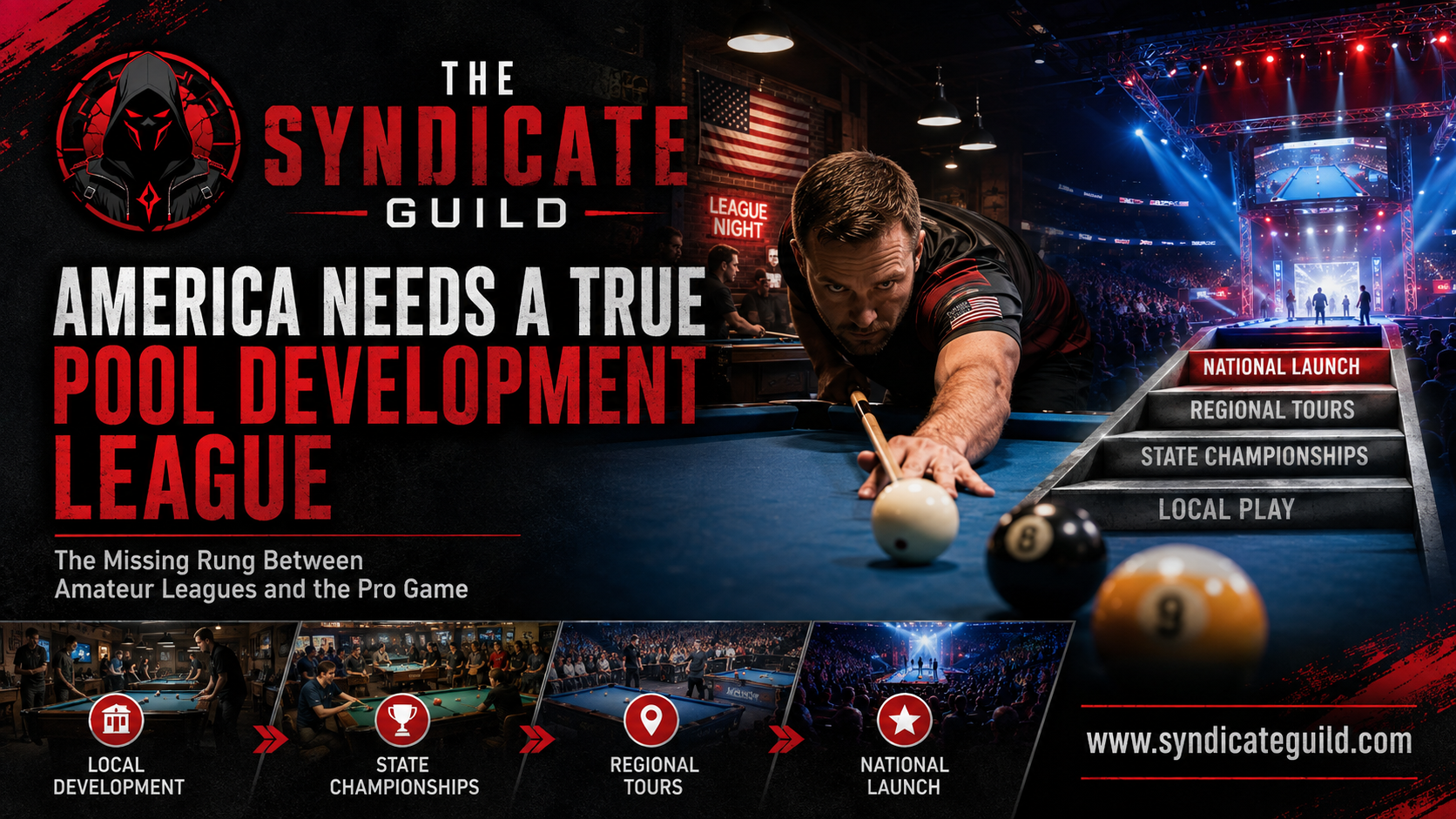
America does not have a pool participation problem. It has a player-development problem.
The United States has thousands of pool rooms, tournament promoters, instructors, equipment manufacturers, regional tours, and weekly leagues. The American Poolplayers Association reports more than 275,000 members across its markets and nearly $2 million in guaranteed annual championship prize money. The BCA Pool League and USA Pool League also provide organized amateur competition, with USA Pool League using FargoRate as part of its player-rating and league-management system.
At the professional end of the sport, players compete through the World Nineball Tour, the Women’s Professional Billiard Association, and other major international organizations. What American pool does not have is one clearly marked, season-long road connecting those two worlds.
A talented league player can become one of the strongest competitors in a city or state and still have no obvious answer to one basic question:
What exactly must I do next to become a professional pool player?
A national pool development league could provide that missing answer.
Editor’s note: This article presents a proposed development model. It is not an announcement of an existing national league.
Key Takeaways
- America already has successful amateur leagues and recognized professional tours, but no unified pathway between them.
- Existing programs create valuable opportunities, yet they remain divided by age, gender, league affiliation, or individual championship status.
- A national pool development league should move players through five stages: local, state, regional, national, and funded professional launch.
- Rankings should reward verified tournament performance rather than travel spending, entry-fee size, or social-media popularity.
- The strongest finishers should receive coaching, travel assistance, professional entries, media training, and sponsorship support.
- The entire concept could begin as a measurable pilot rather than an immediate nationwide rollout.
America Has Pool Participation—but No National Development Path
American pool already possesses many of the ingredients required for player development.
Amateur leagues introduce players to organized competition. Pool rooms provide tables and local communities. Instructors help players improve. Regional promoters create stronger competition. Equipment companies, streamers, and sponsors give the sport commercial support. Professional tours provide the final stage.
What is missing is coordination.
A player can succeed in a local league, win regional events, establish a strong rating, and still have to design a professional pathway alone. There is no widely recognized national structure showing that player where to begin, which standard must be met, what event comes next, and what support is earned after advancement.
Amateur Leagues Solve a Different Problem
Organizations such as the APA, BCA Pool League, and USA Pool League have been enormously important to the growth of pocket billiards. They introduce new players to competition, keep pool rooms active during the week, and give recreational competitors meaningful goals.
Those leagues should not be replaced.
Most amateur leagues are designed primarily to create balanced competition among players of different abilities. Handicaps allow beginners, intermediate competitors, and advanced players to participate within the same system.
That model is excellent for participation. It is not the same thing as a professional development system.
A development system must answer different questions:
- Has the player demonstrated sustained performance under standardized conditions?
- Can the player compete successfully without a handicap?
- Can the player perform on professional equipment and under a shot clock?
- Has the player faced strong regional and national competition?
- Does the player understand professional rules, conduct, and media responsibilities?
- Has the player earned financial assistance to enter the next competitive tier?
At present, those milestones are scattered across different organizations, events, and rating systems.
Existing Bridges Do Not Form a National Ladder
American pool already has programs that demonstrate what a development pathway could accomplish.
The APA U.S. Amateur Championship provides its champions with paid travel, lodging, and entry into a professional event. The Billiard Education Foundation operates junior qualifiers leading to its Junior National Championships and opportunities to represent the United States in world junior competition. Matchroom’s WNT NXTGEN program has created standardized events for players aged 16 and under. The WPBA also works with regional women’s tours that award qualifying positions into professional tournaments.
These programs are valuable, and any new development system should cooperate with them.
The problem is that they remain separate pathways. Some are restricted by age, gender, league affiliation, or championship status. Some provide one professional opportunity rather than a complete competitive season.
None currently serves as a unified national ladder that takes an adult player from local competition through state, regional, and national development before providing multiple funded professional starts.
That is the missing rung.
“Professional” Does Not Have One Consistent Definition
The line between amateur and professional status also varies by organization.
The BCA Pool League operator handbook identifies players above a specified FargoRate threshold as professional for eligibility purposes at its amateur championships. APA rules, by comparison, reserve the organization’s right to determine whether an entrant should be classified as an amateur or professional based on several considerations.
Neither approach is necessarily wrong. Different organizations have different competitions and membership needs.
The inconsistency does show that becoming a professional pool player is not comparable to earning a tour card in golf, being drafted into a major sports league, or moving through a formal minor-league system.
A player can become too strong for certain amateur events while still lacking the ranking, sponsorship, income, and tournament experience required to survive professionally.
That player is not fully amateur and not yet sustainably professional.
That player needs a development league.
The Financial Cliff Between Amateur and Professional Pool
The transition from strong amateur to professional competitor is not only a question of skill. It is also a question of money.
Public entry into the 2026 U.S. Open Pool Championship is listed at $750, with players also required to stay at the designated host hotel during their participation. Public entry for the 2026 Florida Open is listed at $350, with a similar host-hotel requirement.
Those expenses come before:
- Airfare or fuel
- Meals
- Local transportation
- Equipment maintenance
- Practice time
- Lost wages
- Additional tournament entries
Professional events have legitimate operating costs, and major tournaments should not be criticized simply because participation is expensive.
The real problem is timing. Emerging players often encounter these expenses before they have established meaningful sponsorship or consistent prize income.
An American player may be skilled enough to test themselves against professionals but not financially secure enough to take that risk repeatedly.
One tournament entry is an opportunity. A coordinated series of funded opportunities is a pathway.
What a National Pool Development League Should Look Like
The United States does not need another isolated league competing against every organization already operating.
It needs a National Pool Development League that functions as an umbrella between existing amateur leagues and recognized professional tours.
Local APA, BCA Pool League, USA Pool League, and independent players could all enter through affiliated rooms or sanctioned development divisions. Results would follow the player, regardless of the amateur organization through which that player began.
The pathway should contain five clearly defined stages.
Stage One: Local Development Divisions
The first stage would operate through approved pool rooms and existing league operators.
Development matches would differ from normal handicapped league nights. They would use standardized rules, individual competition, and objective reporting. Local play could take place on available equipment, but designated qualifying matches should eventually expose players to nine-foot tables and tournament conditions.
To become eligible for advancement, a player would need to:
- Complete at least 40 recorded development matches during the season
- Maintain an established national player rating or verified match history
- Complete a basic rules, sportsmanship, and professional-conduct course
- Participate in at least one sanctioned local development tournament
- Finish within the top 10 percent of the local standings or meet a published performance standard
Ratings would assist with seeding, opponent evaluation, and competitive integrity. A rating alone would not award promotion.
Players would advance by winning matches, not simply by reaching a number.
Stage Two: State Development Championships
Players who qualify locally would advance to a state-level championship.
Each state could conduct up to four qualifiers during the year, followed by one state championship. Tournament fields would be seeded using verified ratings and prior results, but matches would be played without handicaps.
Nine-ball should serve as the principal discipline because it provides a direct connection to the World Nineball Tour. States could also offer 10-ball and 8-ball as secondary disciplines.
The top eight players from each state championship would become eligible for their regional tour. States with smaller player populations could combine with neighboring states to create viable qualifying territories.
Every state champion should receive more than a trophy. The championship package should include:
- Regional entry fees
- An official jersey
- Lodging assistance
- Access to an approved coach
This is where achievement would begin turning into opportunity.
Stage Three: Regional Challenger Tours
The country could be divided into six development regions:
- Northeast
- Southeast
- Midwest
- South Central
- Mountain
- West
Each region would conduct five ranking events per season. A player’s best four finishes would count toward the regional standings, preventing one scheduling conflict or poor result from destroying an entire season.
Regional events would include an open division and a dedicated women’s division. Women would remain eligible to enter the open division, while the women’s pathway would guarantee access to qualifying opportunities associated with professional women’s competition.
Regional tournaments should provide:
- A minimum number of guaranteed matches
- Live digital scoring for every table
- Recorded or streamed feature-table matches
- Published player profiles and season statistics
- Certified referees during later rounds
- Consistent equipment and playing conditions
- Coaching and match-analysis sessions
- Travel awards for the next competitive stage
The top eight open players from each region would advance to the National Challenger Championship. The top four women from each region would advance to the women’s national field.
Additional national positions would be awarded through season points and a final last-chance qualifier.
Stage Four: The National Challenger Championship
The National Challenger Championship should include a 64-player open field and a 32-player women’s field.
The open field could include:
- 48 regional qualifiers
- 12 national points leaders
- 4 last-chance qualifiers
The women’s field could include:
- 24 regional qualifiers
- 6 national points leaders
- 2 last-chance qualifiers
A group phase would guarantee each player several meaningful matches before the elimination rounds. That would provide more developmental value than asking an emerging player to spend hundreds of dollars traveling across the country only to be eliminated after two short matches.
The national event should reproduce professional expectations:
- Nine-foot tournament tables
- Standardized racks, balls, and cloth
- Professional break rules
- Shot clocks during designated rounds
- Enforced dress and conduct standards
- Pre-match player introductions
- Recorded statistics
- Post-match interviews
- National streaming coverage
The objective would not simply be to identify who can run racks.
It would identify who is prepared to perform as a professional competitor.
Stage Five: A Funded Professional Launch Package
The greatest difference between this league and a traditional amateur championship would be what happens after the final match.
The leading players should receive a structured professional launch package.
The top 16 open players and top eight women would earn a one-year Challenger Card providing free entry into the following season’s regional development events.
The top eight open players and top four women would receive funded entry and lodging for at least two approved professional events, using World Nineball Tour, WPBA, or other recognized events as appropriate and subject to each professional organization’s eligibility requirements.
Each national champion would receive a one-year campaign package containing:
- Entry into at least four approved professional tournaments
- A defined airfare and lodging allowance
- Professional coaching and match analysis
- Sports psychology or performance coaching
- Media and interview training
- A professional player biography and promotional package
- Assistance presenting sponsorship proposals to businesses
- Financial education covering expenses, taxes, and prize income
This would transform the national championship from a destination into a launchpad.
Rankings Must Reward Performance, Not Spending
A development league cannot become a system in which the player with the largest travel budget automatically earns the highest ranking.
Only a player’s best four regional results should count. Tournament points should be published before the season and adjusted by a modest strength-of-field multiplier.
A possible points structure could award:
- 1,000 points to the champion
- 750 points to the runner-up
- 550 points to semifinalists
- 400 points to quarterfinalists
- 250 points to players finishing ninth through 16th
- Progressively smaller totals through the remainder of the field
The strength-of-field multiplier could range from 0.90 to 1.10 based on the established ratings of the participants. That would recognize stronger victories without allowing ratings to replace tournament results.
Entry-fee size, promoter discretion, and social-media popularity should have no effect on rankings.
Tiebreakers should be decided by:
- Head-to-head results
- Match-winning percentage
- Opponent-adjusted performance
Players Must Be Allowed to Graduate
The development league should not become another amateur system dominated indefinitely by the same elite competitors.
A player who establishes recognized professional status, reaches a published professional-ranking benchmark, or completes a successful funded professional season should graduate from the developmental field.
Graduated players could return as:
- Coaches
- Commentators
- Mentors
- Team captains
- Tournament ambassadors
They should not continue collecting development money intended for the next group of emerging competitors.
A player who later loses professional standing could petition to return after a specified period. The rules should be transparent and applied consistently.
Promotion must be celebrated. Relegation or requalification must not be treated as humiliation. Both are normal parts of a legitimate sports structure.
Player Development Must Include More Than Tournament Entry
Professional readiness requires more than cue-ball control.
Development players need education in:
- Sponsorship
- Public relations
- Personal branding
- Physical conditioning
- Scheduling and travel
- Financial management
- Taxes and prize income
- Professional conduct
- Media interviews
A talented competitor who cannot communicate with sponsors, arrive prepared for interviews, or manage travel expenses will struggle to build a sustainable career.
Every regional tour should therefore include clinics led by instructors, professional players, referees, tournament directors, and sports-business professionals.
The league should develop complete competitors—not merely tournament entrants.
How a National Pool Development League Could Be Funded
A national pathway must be financially transparent and should not depend entirely on players funding one another.
A pilot program could begin with:
- A modest annual development membership
- A small amount earmarked from qualifying-event entries
- Host-room contributions
- Equipment sponsorships
- Streaming partnerships
- National presenting sponsors
A predetermined percentage of central revenue should be reserved exclusively for player travel, lodging, coaching, and professional entries.
Annual financial reports should disclose:
- Total player fees collected
- Sponsor and host contributions
- Prize money distributed
- Travel assistance awarded
- Administrative expenses
- Media and production costs
Players will support a development fund when they can see where the money goes and how advancement is earned.
Why Existing Pool Organizations Would Benefit
A national development league would not weaken amateur organizations. It would give their strongest and most ambitious members a reason to remain engaged.
League operators could tell a new member that the organization offers both recreational competition and a legitimate path toward higher-level play.
Pool rooms would gain:
- Recurring qualifiers
- Regional events
- Spectators
- Streaming exposure
Professional promoters would receive competitors who already understand tournament rules, shot clocks, media expectations, and professional conduct.
Sponsors would gain season-long stories instead of isolated tournament appearances. Fans could follow players from local qualification through state championships, regional competition, and ultimately the professional stage.
American professional pool would gain a deeper and better-prepared talent pool.
Start With a Measurable National Pilot
The entire system does not have to be built at once.
A serious pilot could launch with:
- Four regions
- Approximately 20 participating pool rooms
- 1,000 registered players
- Three regional events per territory
- One national championship
Success should be measured through concrete outcomes:
- Player retention from local through regional competition
- Number of professional entries funded
- Percentage of promoted players who cash in professional events
- Sponsorship revenue generated
- Streaming audiences and viewing hours
- Participation by women and graduating junior players
- Number of affiliated rooms returning for the second season
The pilot would reveal which formats, qualification rules, and financial models should be expanded nationally.
Frequently Asked Questions
What is a national pool development league?
A national pool development league would be a structured pathway connecting amateur competition with recognized professional tours. Players would advance through local, state, regional, and national stages before earning funded professional opportunities.
Would this league replace the APA, BCA Pool League, or USA Pool League?
No. The proposal is designed as an umbrella pathway that works with existing amateur leagues, independent players, pool rooms, instructors, promoters, and professional organizations.
How would players qualify for the next level?
Players would advance through verified match results and published tournament standards. Ratings would support seeding and integrity, but promotion would depend on competitive performance rather than rating alone.
Why should nine-ball be the primary discipline?
Nine-ball provides the clearest direct connection to the World Nineball Tour and major international professional events. State and regional programs could still offer 8-ball and 10-ball as secondary disciplines.
How would emerging players afford professional events?
The strongest finishers would receive funded entries, lodging, travel assistance, coaching, and sponsor-development support. Central league revenue and sponsorship money would reserve a defined portion specifically for professional launch expenses.
What would players earn after the national championship?
Top finishers could earn Challenger Cards, free regional entries, funded professional starts, coaching, media training, sponsorship assistance, and financial education. National champions would receive a complete one-year campaign package.
How would the league prevent wealthy players from buying ranking points?
Only a player’s best regional results would count. Published points, modest strength-of-field adjustments, and transparent tiebreakers would reward performance rather than the number of events a player can afford to attend.
America Needs a Bridge, Not Another Dead End
American pool already possesses the players, rooms, leagues, promoters, instructors, manufacturers, and professional events necessary to build a legitimate development structure.
What it lacks is coordination.
The sport should not continue telling ambitious players to join an amateur league, improve on their own, pay their way into an open professional tournament, and hope someone notices them.
A legitimate sport shows its competitors where to begin, what standards they must meet, what event comes next, and what they will earn when they succeed.
Pool does not need another disconnected championship.
It needs a bridge.
A national pool development league could become that bridge—connecting recreational and amateur competitors with professional opportunities that currently feel distant, expensive, and uncertain.
The next great American professional may already be competing on a Tuesday night in a neighborhood pool room.
The future of the sport depends on building a road that allows that player to reach the professional arena.