WoW Mythic+ Guild Family: Progress Beyond the LFG Lottery
Leave the LFG lottery behind. Learn how a WoW Mythic+ Guild Family builds reliable teams through shared routes, clear calls, preparation, and trust.
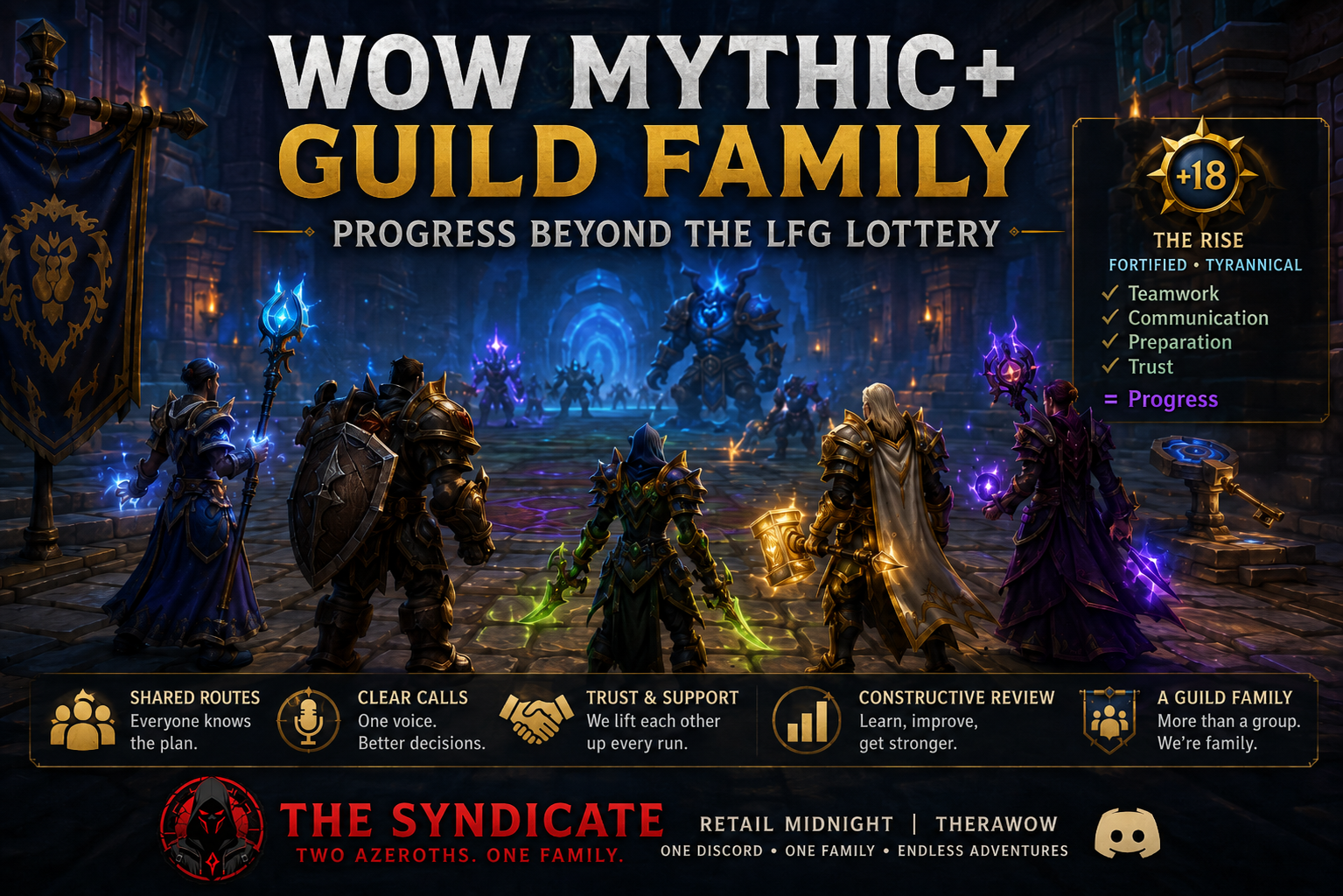
The LFG tool can fill a roster, but it cannot create trust. You can spend forty minutes checking scores, item levels, and class combinations only to watch a key fall apart after one missed interrupt and a silent departure. The keystone drops, the group disappears, and the evening feels wasted.
A dependable WoW Mythic+ Guild Family changes that experience. Not because anyone is buying access or receiving guaranteed clears, but because players learn together, communicate clearly, and show up for one another. Shared routes replace guesswork. Familiar voices replace five competing plans. Constructive review replaces blame.
That is the difference between rolling the dice with strangers and progressing with a team.
Key Takeaways
- A WoW Mythic dungeon group community becomes stronger when it operates as a Guild Family rather than a collection of temporary players.
- Consistent Mythic+ progress comes from shared routes, clear calls, role coordination, preparation, and honest review.
- Friendly and structured are not opposites. The best groups combine camaraderie with respect for everyone’s time.
- Reliability, communication, and a willingness to improve matter as much as raw score or item level.
- The Syndicate organizes Mythic+ around Discord, teamwork, shared resources, and a family-first guild culture.
Beyond the LFG Lottery
Random groups are not unreliable because every stranger is a bad player. They are unreliable because the group has no shared history, no established communication style, and no reason to remain together after the run ends.
One player expects a skip. Another expects the tank to pull normally. Two players overlap interrupts. A defensive cooldown is used at the same time as a healer cooldown. After the first wipe, someone leaves because there is no relationship to protect and no next run to prepare for.
This is the LFG lottery: every key starts with a new set of assumptions.
A Guild Family reduces those variables. Players know the route language. They understand who normally makes the calls. They recognize each other’s strengths, habits, and learning goals. A rough pull becomes something the group can fix instead of a reason to disband.
The Guild Family Advantage
A healthy WoW Mythic dungeon group community creates consistency through teamwork:
- Shared expectations: Everyone understands the goal of the run before the key begins.
- Mutual support: Mistakes are addressed directly without turning the player into the problem.
- Familiar roles: Tanks, healers, damage dealers, and utility players learn how to work around one another.
- Organized scheduling: Discord signups and role planning reduce the time spent searching for a group.
- Collective learning: Routes, builds, clips, and lessons are shared so the whole family improves.
The result is not a promise that every key will time. Mythic+ still demands execution, adaptation, and patience. The difference is that a failed run produces useful information and a stronger team for the next attempt.
The Teamwork Behind Consistent Mythic+ Runs
High-key execution is rarely the work of one standout player. It comes from five people making connected decisions at the right time.
One Clear Voice, Not Five Competing Calls
Every group benefits from a primary shotcaller. This player keeps the team aligned on pull order, skips, priority targets, dangerous casts, and major cooldown windows.
Good shotcalling is not about controlling the group. It is a service to the group. The caller reduces noise so everyone else can focus on execution.
Other players still communicate essential information:
- Interrupt unavailable
- Defensive active
- Crowd control ready
- Battle resurrection available
- Major damage cooldown coming up
- Route adjustment needed
The goal is concise, useful communication. During a difficult pull, the group needs the next decision—not a complete narration of the fight.
Role Synergy Beyond Tank, Healer, and Damage
The basic trinity matters, but successful Mythic+ teams also plan around utility.
Interrupt orders prevent two players from kicking the same cast. Crowd-control chains keep dangerous enemies locked down without wasting stuns. Defensive rotations help the healer prepare for incoming damage. Dispels, externals, battle resurrections, movement tools, and group buffs all become part of the route.
This is where repeated runs with a Guild Family create an advantage. Players stop reacting as five individuals and begin anticipating one another.
A tank knows when the healer has a major cooldown ready. A damage dealer knows which cast belongs to them. A utility player knows when to hold a stop for the next pack. Those small connections are what turn a difficult route into a manageable one.
Preparation Starts Before the Keystone
A clean run begins before the countdown.
The group should agree on the route, review any risky line-of-sight pulls, confirm interrupt responsibilities, and identify the moments that require major defensives or damage cooldowns. Consumables, repairs, talents, and gear should be handled before the group enters.
Preparation also includes the player’s interface. Affix alerts, interrupt tracking, defensive timers, and clear nameplates should help you make faster decisions rather than add more visual noise.
The Syndicate’s Midnight build hub and Midnight starter hub give players a shared starting point for builds, gearing, consumables, and role preparation. The purpose is not to force every character into one template. It is to make sure the team is working from the same current information.
Review Without Blame
A Guild Family does not pretend mistakes did not happen. It handles them in a way that improves the next run.
After a difficult key, review the moments that changed the outcome:
- Which dangerous cast went through?
- Where did the route lose time?
- Were defensive cooldowns layered or wasted?
- Did the pull size match the group’s available tools?
- Was a death caused by positioning, missed utility, or an unclear call?
Focus on one or two practical adjustments. A review should end with a plan, not a pile of accusations.
Accountability and respect belong together. Owning a mistake builds trust. Helping a teammate correct one strengthens the whole group.
Friendly and Structured Belong Together
Some players assume they must choose between a friendly guild and a serious progression group. That is a false choice.
A strong Guild Family can laugh between pulls, welcome developing players, and still care about preparation, punctuality, and improvement. Camaraderie is not the enemy of performance. In many groups, it is the reason players stay calm enough to solve difficult content together.
Structure should protect the team, not make the game feel like a second job.
What to Look For in a Mythic+ Guild Family
Look for a community with:
- Clear event signups and scheduling
- Leaders who explain expectations before the run
- Shared routes and current build information
- Constructive feedback instead of public humiliation
- Space for experienced players and developing players
- Fair role planning based on availability and group needs
- A culture that values the person behind the character
- A willingness to learn from failed keys rather than hide them
Avoid groups that advertise certainty where none exists. No guild can honestly guarantee that every composition will time every key. What a dependable Guild Family can offer is a better process: organized groups, clearer communication, shared preparation, and teammates who intend to return for the next run.
Preparing to Be a Dependable Teammate
Joining an organized Mythic+ group begins with your own preparation. You do not need to arrive as a perfect player. You do need to arrive ready to contribute and willing to improve.
Technical Preparation
Know the core purpose of your class and specialization. Understand your major damage or healing windows, defensives, interrupts, dispels, crowd control, and movement tools.
Before a scheduled run:
- Review your talents and current gearing direction.
- Bring the appropriate consumables.
- Repair your gear.
- Check the planned route and dungeon mechanics.
- Configure your interface for fast, readable information.
- Review a recent log or clip when you are working on a recurring problem.
Throughput matters, but it is only one part of performance. A player who produces strong numbers while missing every priority interrupt can still make the run harder. The most valuable teammate understands both their rotation and their responsibility to the group.
Communication and Feedback
Technical skill may earn attention, but communication earns trust.
Keep calls short and relevant. Say when your interrupt is unavailable. Announce a defensive when the healer needs to know. Ask for clarification before the key rather than guessing during a dangerous pull.
Feedback should be handled the same way. Listen for the useful part, ask questions, and turn the note into an adjustment. A correction from a raid lead, tank, healer, or teammate should be treated as shared problem-solving—not a personal attack.
Reliability Builds Your Reputation
A dependable player:
- Shows up when they sign up
- Communicates early when plans change
- Stays through recoverable mistakes
- Owns errors without making excuses
- Helps newer players understand the plan
- Respects the time of the other four people
- Celebrates team progress, not only personal score
Raw talent can win a pull. Reliability builds a roster.
How The Syndicate Approaches Mythic+
The Syndicate is built around a simple idea: Two Azeroths. One family. Our retail Midnight crew and our TheraWoW crew share the same Discord, officers, rank structure, and team-first culture.
For Mythic+, that means Discord acts as the family table. Players post their role, schedule, goals, and preferred key range. Event leads organize groups around availability and composition. Experienced players share routes, builds, and practical lessons. Developing players get a clearer path to improvement instead of being left alone in the Group Finder.
Our family ranks provide organization and responsibility, not price levels. Capos and event leads coordinate. Regular players help fill groups and mentor newer members. New recruits learn the communication style and find the crew that fits their schedule and goals.
What Guild Family Teamwork Looks Like
- Organized Mythic+ key nights
- Role-balanced group planning
- Shared route and build notes
- Clear voice communication
- Constructive review after difficult runs
- Opportunities to rotate players as schedules allow
- Help with gearing, UI setup, mechanics, and class questions
- Respect for working adults with limited play time
Run spots are organized through signups, availability, role balance, and team needs. They are not purchased, and no clear is guaranteed. The value comes from people choosing to prepare together and support one another over time.
That is what makes a guild different from a queue.
Take Command of Your Progression—Together
The LFG lottery can turn Mythic+ into a cycle of waiting, guessing, and starting over. A dependable WoW Mythic dungeon group community breaks that cycle by giving players a shared language and a reason to keep building after the key ends.
High-key progress is not only about score. It is about trust: knowing the tank has a plan, the healer can call for help, the damage dealers will handle their assignments, and the group will review mistakes without tearing itself apart.
The Syndicate’s Guild Family brings that teamwork into one Discord and one organized community. Bring your character, your preferred role, your schedule, and your goals. We will help you find the right crew, learn the family’s approach, and start building consistency one key at a time.
Stop gambling on temporary groups. Start progressing with a Guild Family.
Frequently Asked Questions
What is a WoW Mythic dungeon group community?
It is a network of players who organize Mythic+ runs outside random matchmaking. A strong community uses shared routes, event signups, voice communication, role planning, and repeated teamwork to make dungeon progression more consistent.
Why call it a Guild Family?
Guild Family describes a relationship built on loyalty, support, and shared responsibility. Players are not customers receiving a service. They are teammates who contribute to the group, help one another improve, and protect the community’s culture.
Do I need a high Mythic+ score to join organized runs?
Not every group should have the same entry point. Good guilds organize different key ranges and set expectations before the run. Preparation, communication, and willingness to learn can matter as much as a current score, especially when a player is building experience.
Can I push higher keys without a consistent team?
Yes, but the process is usually less predictable. Random groups require you to rebuild communication and route expectations every time. A consistent team develops trust, coordinated utility, and a shared understanding of how to recover when a pull goes wrong.
How should Mythic+ groups be organized for working adults?
Use scheduled start times, clear signups, realistic run windows, and early communication about absences. The group should enter prepared so limited game time is spent playing rather than waiting for consumables, talent changes, or route discussions.
How are runs organized in The Syndicate?
Runs are planned through Discord using player availability, roles, key levels, and group needs. Event leads work to create balanced groups and fair opportunities while recognizing that schedules and compositions change. The goal is reliable teamwork, not purchased slots or promised outcomes.
What resources does The Syndicate share?
The guild site and Discord provide build information, gearing direction, consumable notes, role discussions, event planning, and practical lessons from guild activities. Members also help one another with mechanics, UI questions, route preparation, and character development.
How does a Guild Family handle toxic behavior?
Shared standards create accountability. Problems are addressed directly and respectfully, with the focus on what happened and how to improve it. Blame, humiliation, and one-wipe-and-quit behavior undermine the team and should not define organized guild play.